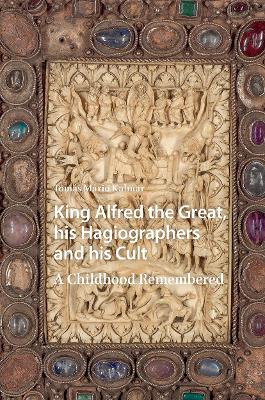
This book situates Alfred the Great in his hagiographic context. For 150 years, the fables told in the ninth century about Alfreds childhood have posed interlocking disciplinary challenges to historians committed to evicting romance from history. Blending current Hagiography Studies with historical, literary, and biblical hermeneutics can help us forgo the anti-hagiographic commitments which motivated the scholars who purified the Victorian cult of Alfred by expunging his legends and salvaging his historicity. The book focusses on the typological functions of three Alfredian fables from the Old English Chronicle, the Old English Boethius, and Assers Vita Ęlfredi, analyses the plot common to all three, critiques the psychological conjecture that Alfreds childhood memory was their common source, and shows that synoptically they can help us see how Alfred shaped the curve of his own lifes destiny and how he engaged in the formation of his own cult to last a thousand years.
Foreword by Andrew Prescott, Acknowledgments, Some Key Dates, I Cult and
Canon: The Chronicle, 1 Kiss the Reliquary, 2 Remember the Pope, 3 Fix the
Date, II Too Good to be True: The Life, 4 Write the Life, 5 Win the Book, III
The Curve of Destiny: The Works, 6 Cross the Border, 7 Win the Crown.
An independent Latino scholar living in Vermont, Tomįs Kalmar (Ed.D., Harvard) specializes in interdisciplinary Alfredian Studies. He has published on Alfred and Asser in EOLAS and Peritia. He is the author of Illegal Alphabets and Adult Biliteracy (Routledge 2015).

 Rohkem infot Taylor & Francis e-raamatute kohta