Update cookies preferences

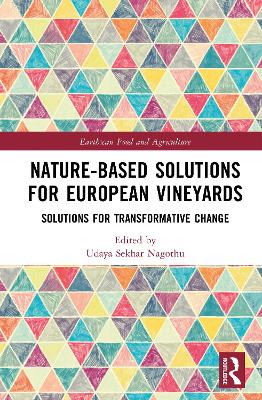
Nature-Based Solutions for European Vineyards: Solutions for Transformative Change [Hardback]

Edited by (Bioforsk, Norwegian Institute of Agricultural and Environmental Research, As, Norway)
  • Format: Hardback, 298 pages, height x width: 234x156 mm, 23 Tables, black and white; 4 Line drawings, black and white; 27 Halftones, black and white; 31 Illustrations, black and white
  • Series: Earthscan Food and Agriculture
  • Pub. Date: 25-Jun-2026
  • Publisher: Routledge
  • ISBN-10: 1041201133
  • ISBN-13: 9781041201137
Other books in subject:
  • Hardback
  • Price: 159,19 €*
  • * the price is final i.e. no additional discount will apply
  • Regular price: 212,25 €
  • Save 25%
  • This book is not yet published. Book will arrive in about 3-4 weeks after it is published. Please allow another 2 weeks for shipping outside Estonia.
  • Quantity:
  • Add to basket
  • Delivery time 2-4 weeks
  • Add to Wishlist
  • Format: Hardback, 298 pages, height x width: 234x156 mm, 23 Tables, black and white; 4 Line drawings, black and white; 27 Halftones, black and white; 31 Illustrations, black and white
  • Series: Earthscan Food and Agriculture
  • Pub. Date: 25-Jun-2026
  • Publisher: Routledge
  • ISBN-10: 1041201133
  • ISBN-13: 9781041201137
Other books in subject:

This transdisciplinary book explores the potential benefits and challenges of implementing nature-based solutions in vineyard landscapes across a range of European countries. It will be of great interest to students, scholars and professionals working on nature-based solutions, agriculture, viticulture and environmental management.


This transdisciplinary book explores the potential benefits and challenges of implementing nature-based solutions in vineyard landscapes across a range of European countries.

Most agricultural landscapes including vineyards have abandoned their traditional management practices making them vulnerable to climate extremities, biologically impoverished and highly susceptible to pests and diseases. There is now a growing awareness among wine producers and consumers about the importance of managing vineyards sustainably through nature-based solutions. This volume examines vineyard landscapes in a range of European countries, including Italy, Switzerland, Spain, France and Portugal, analysing the potential of sustainable nature-based solutions in improving ecosystem health, while prioritizing wine quality and social and economic gains. Drawing on the experiences of scientists from varied backgrounds, including natural and social scientists, vineyard managers, wine producers and environmental agencies working in vineyard landscapes, chapters present evidence-based research results demonstrating the environmental, social and economic effectiveness of nature-based solutions through a range of bio-based approaches, including organic, biodynamic and regenerative farming approaches. The volume delves into the transformative potential of nature-based solutions, presenting novel pathways, applications, evidence-based cases, and experiential assessments of nature-based solutions in different agroecological settings.

This book will be of great interest to students, scholars and professionals working on nature-based solutions, agriculture, viticulture and environmental management more broadly.

Reviews

'Viticulture connects pleasure with nature. This book presents a range of practical, real-world ways to implement nature-based solutions for better winemaking, providing a valuable tool to support policies that promote more sustainable production and improved biodiversity conservation, while also enhancing peoples enjoyment.'

Marc Vilahur Chiaraviglio, Director General de Polítiques Ambientals i Medi Natural, Generalitat de Catalunya

'This book offers a profound analysis of the causes and effects of climate change, featuring precise observations and firsthand accounts from diverse environments. It serves as an essential guide for approaching viticulture with a contemporary focus, aimed at tackling the new environmental challenges we face, while preserving territorial identity and maintaining its inherent suitability for winegrowing.'

President of Consortium Barolo Barbaresco Alba Langhe Dogliani, Piedmonte, Italy

'Vineyards and wine production are a perfect example of the interplay between nature, culture, and the economy. For centuries, we have nurtured and developed this activity, adapting it to social, economic, and natural changes.

The work is not concluded, and we have to continuously adapt to an evolving environment and to new challenges. An approach based on the concept of nature-based solutions encourages a proper and balanced consideration of all aspects.

The collection of experiences and research examples from viticulture around the world on best practices for biodiversity in vineyards, presented in this book, demonstrates that this work is underway in many countries and makes for excellent reading for both those who love vineyards and wine and nature lovers.'

Dr. Bruno Oberle, President of World Resources Forum Association, State Secretary of Environment, Switzerland.

1. Nature based solutions to address global challenges: the development
agenda versus the scientific dilemma
2. Overview of current research in
multi-taxon assessment of vineyard biodiversity, ecosystem functions and
effects of production systems
3. The role of soil microbiomes in vineyard
sustainability and wine quality
4. Assessment of soil restoration using
organic conditioners to improve vineyard soil health
5. Nature-based
permanent green covers in vineyards: functional selection and promotion of
native ecotypes, based on experiences from Switzerland
6. When pests come
from outside of the vineyard: risks and opportunities from a landscape
management perspective based on case studies in Switzerland
7. From yeast
community associated with grape to apiaries located in vineyards
8. Promoting
biodiversity in vineyards through agri-environmental schemes and
complementary approaches
9. Building a Farm Organism and Nature-based
Solutions (NbS) assessment in the Biodynamic Approach
10. Familia Torres'
experience in the implementation of regenerative viticulture in Spain and
Chile
11. Regenerative farming approach at Quinta de Covela vineyards to
reconcile high-value viticulture, ecosystem restoration and climate
resilience in Portugal.
12. Nature based solutions to improve biodiversity
and ecosystem health in vineyards: case studies from France
13. Nature-Based
Solutions and Organic Viticulture in the Biodistretto del Chianti
14.
Implementing supportive policies to promote nature-based solutions at
regional level through collaboration with winegrowers: the case of Piedmont
Region, Italy
15. Regenerative viticulture: leading sustainability in
winemaking. The RVA certification
16. Enhancing and upscaling Nature-based
solutions Summary and recommendations.
Udaya Sekhar Nagothu is Research Professor and Director at the Centre for International Development, Norsk Institutt for Biookonomi/Norwegian Institute of Bioeconomy Research (NIBIO), Norway. He is the editor of Climate Neutral and Resilient Farming Systems (2023), The Bioeconomy Approach (2020), Agricultural Development and Sustainable Intensification (2018), Climate Change and Agricultural Development (2016) and Food Security and Development (2015).