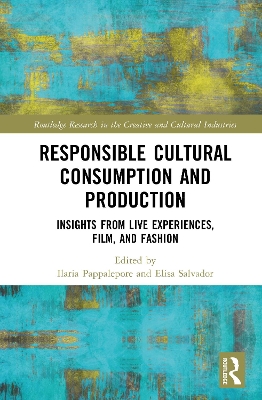
Exploring the Sustainability Development Goal for Responsible Consumption and Production, this volume provides insights from the performing arts, festivals and events, film industry, and fashion sectors.
With a variety of examples and case studies, contributors illuminate the political and social importance of the creative and cultural industries in driving sustainable transitions. The influence of policy, funding, and international standards are also considered, alongside other key themes such as social entrepreneurship, the post-growth economy, and the importance of overcoming barriers to equity, equality and social justice.
Alongside a sister publication, Responsible Consumption and Production in the Creative and Cultural Industries, this edited book explores how creative and cultural organisations embrace the challenge of sustainable development, highlighting best practice across geographic and cultural contexts. The result is a comprehensive overview that is valuable reading for research, policy and practice.
Alongside a sister publication, Responsible Consumption and Production in the Creative and Cultural Industries, this edited book explores how creative and cultural organisations embrace the challenge of sustainable development, highlighting best practice across geographic and cultural contexts.
Foreword (Judith Mair) Introduction: The Creative and Cultural
Industries transition towards responsible practice: from policy to action
(Elisa Salvador & Ilaria Pappalepore) Section 1: Sustainability Transitions
in the Performing Arts Sector
1. Great Expectations: Towards eco-responsible
cultural institutions (Vānia Rodrigues, Fernando Matos Oliveira & António
Ventura)
2. Walking the Eco-Talk: Quality Management Factors to be Considered
by Performing Arts Managers when Implementing Sustainable Development
(Cristian Pulido, Philippe Ravanas & André Courchesne)
3. Responsible Culture
in Iceland: Negotiating values of creativity, climate policies, and
sustainability metrics (Njorour Sigurjonsson & Bergsveinn Porsson) Section 2:
Festivals and Events as Living Labs for Sustainable Practice
4. No Festivals
on a Dead Planet: The transformative potential of cultural festivals through
green growth and degrowth lenses (Erik Vermunt & Carolina Dalla Chiesa)
5.
Sustainable Eventification: A Nexus in Festivals, Events, and Cultural &
Creative Industries (Waldemar Cudny)
6. Green Beats: Let It Roll Festival's
Journey of Eco-Friendly Innovations (Marek Prokupek, Lenka Wimmerovį,
Veronika Vrbovį, Michal Bro & Miroslav Punochį)
7. Community Running
Events as Tools for Inclusion in Serious Leisure Spaces (Jessica Porritt
Best) Section
3. Responsible Production in the film industry: challenges and
opportunities
8. Sustainability Departments in UK Screen Productions: Labour
in the Green Transition (Leora Hadas)
9. Green Practices for Sustainable
Filmmaking (Giorgia Masili) Section 4: The fashion industry: Responsible
Consumption, Social Sustainability and Poverty Alleviation
10. Responsible
Consumption in Fashion: the case of the social cap in Brazil (Joana Martins
Contino & Joćo Dalla Rosa Jśnior)
11. Consumption for Social Sustainability
and Poverty Alleviation (John H. Takamura Jr) Conclusion: Bridging Creativity
and Sustainability: Lessons from live Experiences, film, and fashion (Elisa
Salvador & Ilaria Pappalepore)
Dr Ilaria Pappalepore is a Reader (Associate Professor) and co-convener of the 'Place & Experience' research group in the School of Architecture and Cities of the University of Westminster (London). Ilarias research expertise lies in the intersection between tourism, events, and the creative and cultural industries. Her doctoral research (completed in 2010) looked at the role played by creative industry clusters in the development of tourism in non-central urban areas in London. Her work on the Olympic Games and cultural tourism, which was initially funded by the International Olympic Committee (IOC), spans over 13 years and looked at several case studies including Turin, London, Rio de Janeiro, Tokyo, and, more recently, Paris. In 2020-21 Ilaria led a research collaboration between the University of Westminster and Panthéon-Sorbonne on the future of metropolitan tourism post-COVID-19. Previously, she worked on research on the influence of location-based factors in youth leisure behaviours, funded by the Joseph Rowntree Foundation. Her work has been widely disseminated through international peer-reviewed journals as well as more widely accessible formats such as online open-access articles and podcasts.
Prof. Elisa Salvador holds a Higher Doctorate in economics sciences and management from Paris13 University and an international PhD in Institutions, Economics&Law from the University of Turin (Italy). She has worked on innovation policy for the Italian National Research Council; she has collaborated with the Polytechnic of Turin and the ESCP-Business School; she worked as a researcher at Ecole Polytechnique (Paris, 2012-2015), investigating R&D and innovation in the cultural&creative industries. Currently she is a Professor at ESSCA School of Management (France), where she coordinates the Masters course Managing Creativity&Innovation and the MSc course Technology and Innovation Management. She is Associate Editor of the International Journal of Arts Management (IJAM). She published two books with Routledge in 2022: Managing Cultural Festivals: Tradition and Innovation in Europe and Cultural Industries and the COVID-19 Pandemic: A European Focus.

 Rohkem infot Taylor & Francis e-raamatute kohta