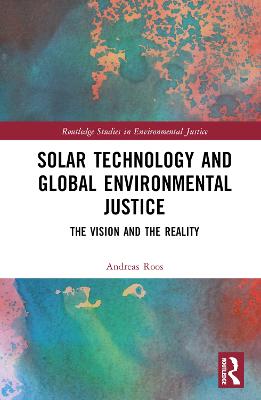
"Building on insights from ecological economics and philosophy of technology, this book offers a novel, interdisciplinary approach to understand the contradictory nature of Solar photovoltaic (PV) technology. Solar photovoltaic (PV) technology is rapidlyemerging as a cost-effective option in the world economy. However, reports about miserable working conditions, environmentally deleterious mineral extraction and toxic waste dumps corrode the image of a problem-free future based on solar power. Against this backdrop, Andreas Roos explores whether 'ecologically unequal exchange' - an asymmetric transfer of labour time and natural resources - is a necessary condition for solar PV development. He demonstrates how the massive increase in solar PV installation over recent years would not have been possible without significant wage/price differences in the world economy - notably between Europe/North America and Asia- and concludes that solar PV development is currently contingent on environmental injustices in the world economy. As a solution, Roos argues that solar technology is best coupled with strategies for degrowth, which allow for a transition away from fossil fuels and towards a socially just and ecologically sustainable future. This book will be of great interest to students and scholars of solar power, philosophy of technology, and environmental justice"--
Building on insights from ecological economics and philosophy of technology, this book offers a novel, interdisciplinary approach to understand the contradictory nature of Solar photovoltaic (PV) technology.
Building on insights from ecological economics and philosophy of technology, this book offers a novel, interdisciplinary approach to understand the contradictory nature of Solar photovoltaic (PV) technology.
Solar photovoltaic (PV) technology is rapidly emerging as a cost-effective option in the world economy. However, reports about miserable working conditions, environmentally deleterious mineral extraction and toxic waste dumps corrode the image of a problem-free future based on solar power. Against this backdrop, Andreas Roos explores whether ‘ecologically unequal exchange’ – an asymmetric transfer of labour time and natural resources – is a necessary condition for solar PV development. He demonstrates how the massive increase in solar PV installation over recent years would not have been possible without significant wage/price differences in the world economy - notably between Europe/North America and Asia- and concludes that solar PV development is currently contingent on environmental injustices in the world economy. As a solution, Roos argues that solar technology is best coupled with strategies for degrowth, which allow for a transition away from fossil fuels and towards a socially just and ecologically sustainable future.
This book will be of great interest to students and scholars of solar power, philosophy of technology, and environmental justice.

 Rohkem infot Taylor & Francis e-raamatute kohta