Muutke küpsiste eelistusi

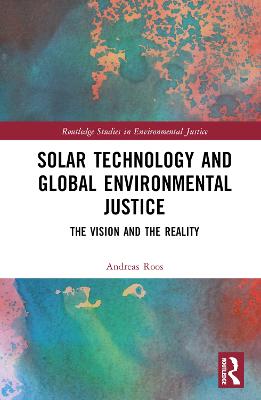
Solar Technology and Global Environmental Justice: The Vision and the Reality [Kõva köide]

  • Formaat: Hardback, 218 pages, kõrgus x laius: 234x156 mm, kaal: 580 g, 16 Tables, black and white; 17 Line drawings, black and white; 17 Illustrations, black and white
  • Sari: Routledge Studies in Environmental Justice
  • Ilmumisaeg: 02-Feb-2023
  • Kirjastus: Routledge
  • ISBN-10: 1032273380
  • ISBN-13: 9781032273389
  • Kõva köide
  • Hind: 144,00 €*
  • * hind on lõplik, st. muud allahindlused enam ei rakendu
  • Tavahind: 192,00 €
  • Säästad 25%
  • Raamatu kohalejõudmiseks kirjastusest kulub orienteeruvalt 3-4 nädalat
  • Kogus:
  • Lisa ostukorvi
  • Tasuta tarne
  • Tellimisaeg 2-4 nädalat
  • Lisa soovinimekirja
  • Raamatukogudele
  • Formaat: Hardback, 218 pages, kõrgus x laius: 234x156 mm, kaal: 580 g, 16 Tables, black and white; 17 Line drawings, black and white; 17 Illustrations, black and white
  • Sari: Routledge Studies in Environmental Justice
  • Ilmumisaeg: 02-Feb-2023
  • Kirjastus: Routledge
  • ISBN-10: 1032273380
  • ISBN-13: 9781032273389
"Building on insights from ecological economics and philosophy of technology, this book offers a novel, interdisciplinary approach to understand the contradictory nature of Solar photovoltaic (PV) technology. Solar photovoltaic (PV) technology is rapidlyemerging as a cost-effective option in the world economy. However, reports about miserable working conditions, environmentally deleterious mineral extraction and toxic waste dumps corrode the image of a problem-free future based on solar power. Against this backdrop, Andreas Roos explores whether 'ecologically unequal exchange' - an asymmetric transfer of labour time and natural resources - is a necessary condition for solar PV development. He demonstrates how the massive increase in solar PV installation over recent years would not have been possible without significant wage/price differences in the world economy - notably between Europe/North America and Asia- and concludes that solar PV development is currently contingent on environmental injustices in the world economy. As a solution, Roos argues that solar technology is best coupled with strategies for degrowth, which allow for a transition away from fossil fuels and towards a socially just and ecologically sustainable future. This book will be of great interest to students and scholars of solar power, philosophy of technology, and environmental justice"--

Building on insights from ecological economics and philosophy of technology, this book offers a novel, interdisciplinary approach to understand the contradictory nature of Solar photovoltaic (PV) technology.


Building on insights from ecological economics and philosophy of technology, this book offers a novel, interdisciplinary approach to understand the contradictory nature of Solar photovoltaic (PV) technology.

Solar photovoltaic (PV) technology is rapidly emerging as a cost-effective option in the world economy. However, reports about miserable working conditions, environmentally deleterious mineral extraction and toxic waste dumps corrode the image of a problem-free future based on solar power. Against this backdrop, Andreas Roos explores whether ‘ecologically unequal exchange’ – an asymmetric transfer of labour time and natural resources – is a necessary condition for solar PV development. He demonstrates how the massive increase in solar PV installation over recent years would not have been possible without significant wage/price differences in the world economy - notably between Europe/North America and Asia- and concludes that solar PV development is currently contingent on environmental injustices in the world economy. As a solution, Roos argues that solar technology is best coupled with strategies for degrowth, which allow for a transition away from fossil fuels and towards a socially just and ecologically sustainable future.

This book will be of great interest to students and scholars of solar power, philosophy of technology, and environmental justice.

Arvustused

"This book is an essential antidote to the illusion that solar technology can save the planet. Rooss contribution reveals solar power for what it truly is."

Derrick Jensen, author of Endgame

"Solar Technology and Global Environmental Justice is incredibly vital. It reveals the hidden connections between the storytelling, global politics, and energy and material impacts of solar power. Rooss breakdown of Germanys energy laundering is especially fascinating to witness. I cant wait to see where he will lead us next."

Ozzie Zehner, author of Green Illusions

Acknowledgments ix
1 Solar technology at the brink
1(20)
Relating solar visions to reality
3(5)
Ecomodernism vs. ecorealism
8(3)
A note on interdiscipUnarity
11(2)
The structure and contents of this book
13(8)
2 Earthing philosophy of technology
21(36)
Does nature matter?
22(4)
What is technology?
26(10)
Foundations for a critical ecological philosophy of technology
36(8)
The technological continuum
44(3)
Gender, race and ecology in technology
47(10)
3 The historical context of solar technology
57(31)
What is a metabolic regime?
57(1)
The rise of the industrial regime
58(8)
The acceleration of the industrial regime
66(9)
Solar power in the new metabolic regime
75(13)
4 Global asymmetries in the rise of solar power
88(35)
The soiar boom
90(5)
Immaterial explanations for the boom
95(5)
Ecologically unequal exchange between Germany and China
100(15)
The vision and the reality of the solar boom
115(8)
5 The inherent politics of global solar technology
123(39)
Questioning solar technology boundaries
127(8)
Power density and global solar visions
135(13)
The political ecology of the technological boundary
148(2)
The vision and the reality of the solar future
150(12)
6 The world and the solar module
162(9)
The world in the solar module
162(2)
The solar module in the world
164(3)
A critical ecological ontology of solar technology
167(4)
7 Solutions beyond solar illusions
171(22)
Realistic envisioning
173(4)
Alternative solar technology
177(6)
Alliances for a metabolic counter-regime
183(10)
Appendix A International trade volumes and embodied resources in the German-Chinese exchange 193(2)
Appendix B Further considerations for calculating "power density extended" 195(9)
Glossary 204(4)
References 208(3)
Index 211
Andreas Roos is an interdisciplinary scholar with a doctoral degree in the field of human ecology. His work draws from ecological economics, environmental history and philosophy of technology to understand the contentious relation between technology and ecology. Rooss most recent work focuses on assessing the potential of renewable energy technologies to transform modern human-environmental relations. Publishing in top ranking journals, Rooss other contributions include ecological perspectives on the digital economy and the possibilities for commons-based energy technology.