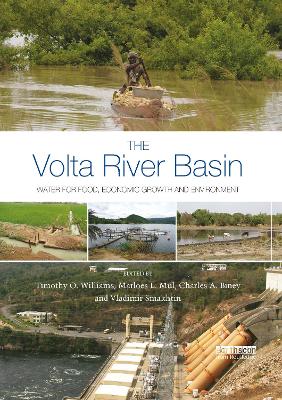
The Volta River Basin (VRB) is an important transboundary basin in West Africa that covers approximately 410,000 square kilometres across six countries: Benin, Burkina Faso, Cōte dIvoire, Ghana, Mali and Togo. Its natural resources sustain the livelihoods of its population and contribute to economic development. This book provides a comprehensive, interdisciplinary review and assessment of the issues and challenges faced.
The authors provide a science-based assessment of current and future scenarios of water availability, the demands of key sectors, including agriculture and hydropower, and the environment under changing demographic, economic, social and climatic conditions. They also identify solutions and strategies that will allow available water resources to be sustainably used to improve agricultural productivity, food security and economic growth in the VRB. Overall, the work examines from a multidisciplinary and multi-stakeholder perspective the solutions and strategies to improve the use of water and other natural resources in the VRB to achieve enhanced food security, livelihoods and economic growth.
Part 1: Introduction
1. Introduction Timothy O. Williams, Marloes L.
Mul, Charles Biney and Vladimir Smakhtin Part 2: Basin Resources: Trends,
Drivers and Status
2. Socioeconomic Status, Trends and Drivers of Change
Shashidhara Kolavalli and Timothy O. Williams
3. Surface Water Resources of
the Volta Basin Marloes L. Mul, Raymond A. Kasei and Matthew McCartney
4.
Groundwater Resources of the Volta Basin Emmanuel Obuobie, Boubacar Barry and
William Agyekum
5. Climate Variability and Change over the Volta River Basin
Mouhamadou B. Sylla, Frank O. Annor, Raymond A. Kasei and Mamadou L. Mbaye
6.
Managing Floods and Droughts Raymond A. Kasei, Barnabas Amisigo and Marloes
L. Mul Part 3: People, Policies and Institutions
7. Poverty, Vulnerability
and Livelihoods in the Volta Basin: A Gendered Analysis Amy Sullivan, Elsie
Odonkor and Nicoline de Haan
8. Water Governance in the Volta Basin Ben
Ampomah, Winston Andah and Charles Biney Part 4: Challenges and Opportunities
in the Use of Water Resources
9. Improving Agriculture and Food Security in
the Volta Basin Augustine Ayantunde, Pamela G. Katic, Olufunke Cofie and
Edward K. Abban
10. Urban and Industrial Development Daniel Van Rooijen, Ben
Ampomah, Josiane Nikiema, Yacouba Noėl Coulibaly and Lydie Yiougo
11.
Water-Food-Energy Nexus and Hydropower Development Emmanuel O. Bekoe, Winston
Andah, Frederick Y. Logah and Bedru B. Balana Part 5: Balancing Development
and Nature
12. Ecosystem Services in the Volta Basin Fred Kizito and Bedru B.
Balana
13. Environmental Flow Requirements in the Volta Basin Marloes L. Mul
and Yongxuan Gao
14. Water Quality and Public Health Chris Gordon, Adelina
Mensah, Josiane Nikiema and Pay Drechsel
15. Sustainable Agricultural
Intensification in the Volta River Basin Timothy O. Williams, Jennie Barron
and Olufunke Cofie Part 6: Governance and Livelihoods
16. Simulating Current
and Future Volta Basin Water Development Scenarios Aditya Sood, Ousmane
Seidou, Gerald Forkuor, Frank O. Annor and Matthew McCartney
Timothy O. Williams is Director for Africa at the International Water Management Institute (IWMI), based in Accra, Ghana.
Marloes L. Mul is a Senior Researcher in Hydrology and Water Resources at the IWMI, Accra, Ghana.
Charles A. Biney is Acting Executive Director of the Volta Basin Authority, based in Ouagadougou, Burkina Faso.
Vladimir Smakhtin was Head of the Water Availability, Risk and Resilience Research Department at IWMI, Colombo, Sri Lanka. He is now the Director of the Institute for Water, Environment and Health (UNU-INWEH), based in Hamilton, Ontario, Canada.

 Rohkem infot Taylor & Francis e-raamatute kohta