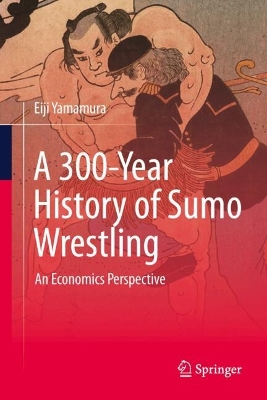
This book traces 300 years of sumo's economic and social history, examining how it survived and evolved through major historical upheavals including the Great Fire of Edo, the Meiji Restoration, and World War II. It explores how sumo developed as immigrants flowed into Edo, and how the tradition has transformed into Japan's most globalized labor market today. The book also analyzes how dismissed Yokozuna (sumo champions) became innovators who reshaped the sumo world.
Domestic Labour Market Mobility and the Sumo Wrestler.- Where Did the
Sumo Wrestler Come From? Globalisation from the Period of High Economic
Growth.- Analysis of Sumo Wrestler Labour Migration: Rural Surplus Labour and
Migration to Urban Areas.- Incentives and Career Performance of Sumo
Wrestlers.- Sumo Wrestler Labour Supply, Unfavourable Weather, and Local
Networks.- David vs Goliath in Sumo.- Progress and Stagnation in
Globalisation.- The International Labour Network Constructed by Minority
Stable Masters: Rule-Breaking and Creative Destruction.- Physical Stature
as Human Capital: Consequences of Globalisation and Rising Injuries.- The
Collapse of Communism and the Globalisation of the Sumo World.- The Impact
of Foreign Sumo Wrestlers on Sumo Stable Performance.- The Mechanism of
Promotion in Sumo.- The Sumo Renaissance and Japanese Sumo Wrestlers.-
Globalisation of Market Competition and the Living Cultural Treasure the
Dignity of Sumo as Such.- References.- Epilogue.
Eiji Yamamura is professor of economics at Seinan-Gakuin University, in Fukuoka, Japan. He earned his B.A. and M.A. from Waseda University and a Ph.D. from Tokyo Metropolitan University in 1995, 1999, and 2004, respectively. His debut work was published in Socio-Economic History, the most prestigious peer-reviewed journal in the field of economic history research in Japan. Subsequently, while publishing papers in various peer-reviewed journals, he has continuously deepened his research on the economic history of sumo wrestling. He has been the executive director of the Association of Behavioral Economics and Finance 2021-2023 and chief editor of Journal of Behavioral Economics and Finance since 2023. His research topics are behavioral economics, sports economics, quantitative economic history, income distribution, and household behavior. He has published over 130 papers in peer-reviewed journals including Social Science Japan Journal, Regional Studies, Papers in Regional Science, Review of Economics and Statistics, Journal of Economic Behavior and Organization, Journal of Population Economics, Journal of Economic Geography, European Journal of Political Economy, Review of World Economics, Review of International Economics, Economics of Education Review, Public Choice, Economics of Governance, Southern Economic Journal, Review of Economics of the Household, Kyklos, Journal of Cultural Economics, Journal of Sports Economics, Social Science and Medicine, and the Journal of the Japanese and International Economies.