Muutke küpsiste eelistusi

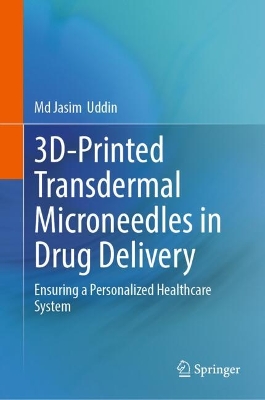
3D-Printed Transdermal Microneedles in Drug Delivery: Ensuring a Personalized Healthcare System [Kõva köide]

  • Formaat: Hardback, 131 pages, kõrgus x laius: 235x155 mm, 14 Illustrations, color; 1 Illustrations, black and white
  • Ilmumisaeg: 15-May-2026
  • Kirjastus: Springer Verlag, Singapore
  • ISBN-10: 9819586275
  • ISBN-13: 9789819586271
  • Kõva köide
  • Hind: 108,52 €*
  • * hind on lõplik, st. muud allahindlused enam ei rakendu
  • Tavahind: 144,69 €
  • Säästad 25%
  • See raamat ei ole veel ilmunud. Raamatu kohalejõudmiseks kulub orienteeruvalt 3-4 nädalat peale raamatu väljaandmist.
  • Kogus:
  • Lisa ostukorvi
  • Tasuta tarne
  • Tellimisaeg 2-4 nädalat
  • Lisa soovinimekirja
  • Formaat: Hardback, 131 pages, kõrgus x laius: 235x155 mm, 14 Illustrations, color; 1 Illustrations, black and white
  • Ilmumisaeg: 15-May-2026
  • Kirjastus: Springer Verlag, Singapore
  • ISBN-10: 9819586275
  • ISBN-13: 9789819586271
This book presents a detailed examination of the transformative impact of three-dimensional (3D) printing on the development of transdermal microneedles for drug delivery. It offers a comprehensive overview of recent technological advancements, encompassing novel materials, emerging fabrication strategies, clinical translation, and evolving regulatory frameworks.


The opening chapter introduces the fundamental concepts of 3D printing as applied to microneedle devices. The book then explores a wide range of additive manufacturing techniques used in microneedle fabrication (e.g., stereolithography, selective laser sintering), followed by in-depth coverage of state-of-the-art 3D printing methodologiesincluding stereolithography, digital light processing, and other photopolymerization-based technologiesas well as advanced biomaterials such as stimuli-responsive polymers and specialized bio inks. Readers will gain insight into the integration of artificial intelligence in microneedle design, innovations in drug encapsulation and loading strategies, and the use of 3D printed microneedles in personalized therapeutics and diagnostics. The book also highlights recent proof concept developments, including bioinspired 4D printed microneedle platforms for pharmaceutical applications. Additionally, the book provides an overview of the commercialization and regulatory landscape for 3D printed microneedles, addressing market translation, intellectual property considerations, regulatory pathways, and innovations that enable scalable manufacturing to support successful market and patient adoption.


Intended for students, researchers, and professionals in the pharmaceutical, biomedical, and healthcare technology sectors, this book delivers a structured and accessible framework for understanding both the current state and future potential of 3Dprinted microneedle systems. It serves as a valuable reference for individuals interested in the convergence of engineering, materials science, and medicine, providing detailed insights into the applications, opportunities, and implications of this rapidly evolving field. Whether you are an academic scholar, an emerging innovator, or an industry practitioner, this book equips you with the knowledge necessary to engage with and contribute to ongoing developments in 3Dprinted microneedle technologies.
Chapter
1. Introduction.
Chapter
2. 3D Printing in microneedle devices:
general concepts.
Chapter
3. Additive manufacturing of 3D printed
microneedles.
Chapter 4: Characterization and evaluation of 3D-printed
microneedles.
Chapter 5: 3D printed microneedles in diagnostic & biomedical
applications.
Chapter 6: 3D printed MNs in disease management.
Chapter 7:
3D printed microneedles in personalized therapy
Chapter 8: A proof of
concept of 3D printed microneedles: bioinspired 4D microneedles.
Chapter 9:
Commercialization & regulatory considerations of 3D printed microneedles-
Chapter 10: Translation of 3D printed microneedles to market and patient
use.
Chapter 11: Future scopes and advancements in the additive
manufacturing of 3D-printed microneedles.
Dr. Md Jasim Uddin is currently working as a Senior Lecturer/UM Expert in the Department of Pharmaceutical Technology, Faculty of Pharmacy, Universiti Malaya, Malaysia. Dr. Uddin has more than 14 years of experience in the areas of pharmaceutics, drug delivery, and formulation science in both academia and the pharmaceutical industry. His research is mainly focused on the development of transdermal microneedle arrays (using 3D printing or molding) for the transdermal delivery of active substances (e.g., small molecules or macromolecules). Due to his industrial experience as a Formulation Scientist in the Department of Drug Product Design and the Worldwide Research & Development Unit at Pfizer UK, he also has a strong background in formulation, material sciences, and characterization.