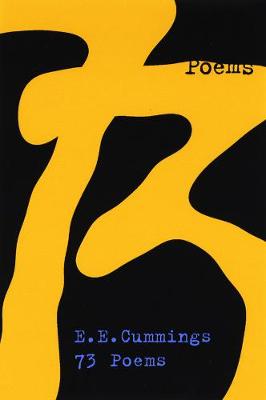
"Cummings...at his most unfoolish and poetic best."—Nation
Four months after Cummings's death in September 1962, his widow, the photographer Marion Morehouse, collected the typescripts of 29 new poems. These poems, as well as uncollected poems published only in periodicals up to that time, make up 73 Poems. This is the final volume in Liveright's reissue of Cummings's individual volumes of poetry, with texts and settings based on E. E. Cummings: The Complete Poems 1904-1962.
"Cummings...at his most unfoolish and poetic best."—Nation
Four months after Cummings's death in September 1962, his widow, the photographer Marion Morehouse, collected the typescripts of 29 new poems. These poems, as well as uncollected poems published only in periodicals up to that time, make up 73 Poems. This is the final volume in Liveright's reissue of Cummings's individual volumes of poetry, with texts and settings based on E. E. Cummings: The Complete Poems 1904-1962.
| 1 O the sun comes up-up-up in the opening |
|
11 | (1) |
| 2 for any ruffian of the sky |
|
12 | (1) |
| 3 seeker of truth |
|
13 | (1) |
| 4 SONG |
|
14 | (2) |
| 5 the first of all my dreams was of |
|
16 | (1) |
| 6 fair ladies tall lovers |
|
17 | (1) |
| 7 it's |
|
18 | (2) |
| 8 plant Magic dust |
|
20 | (1) |
| 9 now is a ship |
|
21 | (1) |
| 10 because it's |
|
22 | (1) |
| 11 humble one(gifted with |
|
23 | (1) |
| 12 Me up at does |
|
24 | (1) |
| 13 O |
|
25 | (1) |
| 14 a great |
|
26 | (1) |
| 15 at just 5 a |
|
27 | (1) |
| 16 e |
|
28 | (1) |
| 17 n |
|
29 | (1) |
| 18 nobody could in superhuman flights |
|
30 | (1) |
| 19 everybody happy? |
|
31 | (1) |
| 20 fearlessandbosomy |
|
32 | (1) |
| 21 why |
|
33 | (1) |
| 22 annie died the other day |
|
34 | (1) |
| 23 nite) |
|
35 | (1) |
| 24 insu nli gh t |
|
36 | (1) |
| 25 a grin without a |
|
37 | (1) |
| 26 if seventy were young |
|
38 | (1) |
| 27 in heavenly realms of hellas dwelt |
|
39 | (2) |
| 28 "right here the other night something |
|
41 | (1) |
| 29 the greedy the people |
|
42 | (1) |
| 30 one winter afternoon |
|
43 | (2) |
| 31 POEM(or |
|
45 | (1) |
| 32 all which isn't singing is mere talking |
|
46 | (1) |
| 33 christ but they're few |
|
47 | (1) |
| 34 "nothing" the unjust man complained |
|
48 | (1) |
| 35 the trick of finding what you didn't lose |
|
49 | (1) |
| 36 if in beginning twilight of winter will stand |
|
50 | (1) |
| 37 now that,more nearest even than your fate |
|
51 | (1) |
| 38 silently if,out of not knowable |
|
52 | (1) |
| 39 white guardians of the universe of sleep |
|
53 | (1) |
| 40 your homecoming will be my homecoming- |
|
54 | (1) |
| 41 a round face near the top of the stairs |
|
55 | (1) |
| 42 n |
|
56 | (1) |
| 43 may i be gay |
|
57 | (1) |
| 44 Now i lay(with everywhere around) |
|
58 | (1) |
| 45 what time is it?it is by every star |
|
59 | (1) |
| 46 out of midsummer's blazing most not night |
|
60 | (1) |
| 47 without the mercy of |
|
61 | (1) |
| 48 t,h;r:u;s,h;ea |
|
62 | (1) |
| 49 faithfully tinying at twilight voice |
|
63 | (1) |
| 50 while a once world slips from |
|
64 | (1) |
| 51 but |
|
65 | (1) |
| 52 who are you,little i |
|
66 | (1) |
| 53 of all things under our |
|
67 | (1) |
| 54 timeless |
|
68 | (1) |
| 55 i |
|
69 | (1) |
| 56 "could that" i marvelled "be |
|
70 | (1) |
| 57 mi(dreamlike)st |
|
71 | (1) |
| 58 &sun& |
|
72 | (1) |
| 59 who is this |
|
73 | (1) |
| 60 2 little whos |
|
74 | (1) |
| 61 one |
|
75 | (1) |
| 62 now does our world descend |
|
76 | (1) |
| 63 (listen) |
|
77 | (2) |
| 64 "o purple finch please tell me why |
|
79 | (1) |
| 65 "though your sorrows not |
|
80 | (1) |
| 66 D-re-A-mi-N-gl-Y |
|
81 | (1) |
| 67 enter no(silence is the blood whose flesh |
|
82 | (1) |
| 68 what is |
|
83 | (2) |
| 69 !hope |
|
85 | (2) |
| 70 pity his how illimitable plight |
|
87 | (1) |
| 71 how many moments must(amazing each |
|
88 | (1) |
| 72 wild(at our first)beasts uttered human words |
|
89 | (1) |
| 73 all worlds have halfsight,seeing either with |
|
90 | (1) |
| Afterword by George James Firmage |
|
91 | |
E. E. Cummings (18941962) was among the most influential, widely read, and revered modernist poets. He was also a playwright, a painter, and a writer of prose. Born in Cambridge, Massachusetts, he studied at Harvard University and, during World War I, served with an ambulance corps in France. He spent three months in a French detention camp and subsequently wrote The Enormous Room, a highly acclaimed criticism of World War I. After the war, Cummings returned to the States and published his first collection of poetry, Tulips & Chimneys, which was characterized by his innovative style: pushing the boundaries of language and form while discussing love, nature, and war with sensuousness and glee. He spent the rest of his life painting, writing poetry, and enjoying widespread popularity and success. George J. Firmage edited many works by Cummings, including Erotic Poems; Complete Poems, 1904 1962; and Fairy Tales.