Muutke küpsiste eelistusi

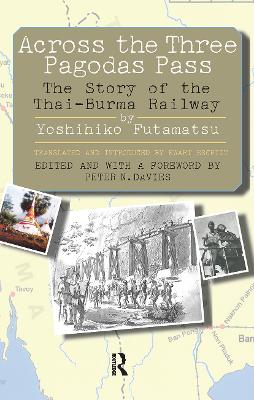
Across the Three Pagodas Pass: The Story of the Thai-Burma Railway New edition [Kõva köide]

Edited by
  • Formaat: Hardback, 300 pages, kõrgus x laius x paksus: 224x146x30 mm, kaal: 500 g, 32 Halftones, black and white; 27 Illustrations, black and white
  • Ilmumisaeg: 01-Jun-2013
  • Kirjastus: Renaissance Books
  • ISBN-10: 1898823073
  • ISBN-13: 9781898823070
  • Kõva köide
  • Hind: 108,56 €*
  • * hind on lõplik, st. muud allahindlused enam ei rakendu
  • Tavahind: 144,75 €
  • Säästad 25%
  • Raamatu kohalejõudmiseks kirjastusest kulub orienteeruvalt 3-4 nädalat
  • Kogus:
  • Lisa ostukorvi
  • Tasuta tarne
  • Tellimisaeg 2-4 nädalat
  • Lisa soovinimekirja
  • Formaat: Hardback, 300 pages, kõrgus x laius x paksus: 224x146x30 mm, kaal: 500 g, 32 Halftones, black and white; 27 Illustrations, black and white
  • Ilmumisaeg: 01-Jun-2013
  • Kirjastus: Renaissance Books
  • ISBN-10: 1898823073
  • ISBN-13: 9781898823070
This is a translation of the only known detailed account of the building of the notorious 262-mile long Thai-Burma Railway by one of the Japanese professional engineers who was involved in its construction. The author, Yoshihiko Futamatsu, provides an invaluable new source of historical and technical reference that complements the existing large body of literature in English on this subject. Futamatsus memoir also includes wide-ranging reflections on the course and conduct of his war as well as his engineering and army experiences. The Thai-Burma Railway took eighteen months to build and cost the lives of some 90,000 people (mostly British, Australian, Dutch and American POWs, as well as great numbers of local labourers) out of a total of over 200,000, including some 12-15,000 Japanese who were engaged in the enterprise. The Three Pagodas Pass was located at the Thai-Burma frontier. Across the Three Pagodas Pass is edited and introduced by Peter N. Davies who provides the back story to the publication of this book and the key people involved. This is followed by translator Ewart Escritts original Introduction to his translation of Futamatsus memoir which also includes a detailed account of his own POW experiences as well as his reflections on the war and its outcomes. Many contemporary original drawings, maps and photographs appear in the plate section.
Acknowledgements ix
Foreword xiii
Peter N. Davies
Introduction xxvii
Ewart Escritt
Across the Three Pagodas Pass lix
Translator's Acknowledgements lxi
Preface lxiii
Yoshihiko Futamatsu
Chapter 1 Departure for the Front
1(2)
Chapter 2 In Indo-China
3(3)
Chapter 3 Opening of Hostilities
6(5)
Chapter 4 The River Krian
11(4)
Chapter 5 The Malayan Campaign
15(3)
Chapter 6 The Fall of Singapore
18(6)
Chapter 7 Surrender
24(5)
Chapter 8 Shonan: Light of the South
29(5)
Chapter 9 The Thai-Burma Railway
34(7)
Chapter 10 Preparing Construction
41(4)
Chapter 11 Banpong
45(6)
Chapter 12 Prisoners-of-War
51(10)
Chapter 13 Constructing the Railway
61(3)
Chapter 14 Thailand
64(3)
Chapter 15 The River Kwae Noi
67(9)
Chapter 16 The Mae Khlaung Bridge
76(6)
Chapter 17 Kanchanaburi
82(4)
Chapter 18 The Jungle
86(3)
Chapter 19 From Bangkok to Singapore
89(5)
Chapter 20 Rush Construction
94(6)
Chapter 21 The Base at Wanyai
100(6)
Chapter 22 The Labour Force
106(5)
Chapter 23 Survey Unit
111(5)
Chapter 24 Test Run
116(3)
Chapter 25 Bridge-Building and Shifting Earth
119(3)
Chapter 26 The Rainy Season: The Monsoon
122(5)
Chapter 27 Kinsaiyok
127(7)
Chapter 28 Diseases and Epidemics
134(4)
Chapter 29 Cattle Drive
138(9)
Chapter 30 Living in the Jungle
147(7)
Chapter 31 Soon to the Three Pagodas Pass
154(3)
Chapter 32 Towards the Setting Sun
157(17)
Chapter 33 Opening to Traffic
174(5)
Chapter 34 The Bombing
179(7)
Chapter 35 End of the War
186(4)
Chapter 36 Internment
190(7)
Chapter 37 Repatriation
197(4)
Footnote 201(2)
Postscript 203(2)
End Notes 205(6)
Glossary 211(7)
Bibliography 218(5)
Index 223
Peter N. Davies is Emeritus Professor of Economic History at Liverpool University. A former President of both the International Commission for Maritime History and of the International Maritime Economic History Association, he has also served as a Visiting Professor at Musashi University, Tokyo, and at Shudo University, Hiroshima. He is the author numerous books including The Trade Makers, Elder Dempster in West Africa (1973), The Man Behind the Bridge: Colonel Toosey and the River Kwai (1991) and, most recently, The Business, Life and Letters of Frederick Cornes: Aspects of the Evolution of Commerce in Modern Japan, 1861-1910 (2008).