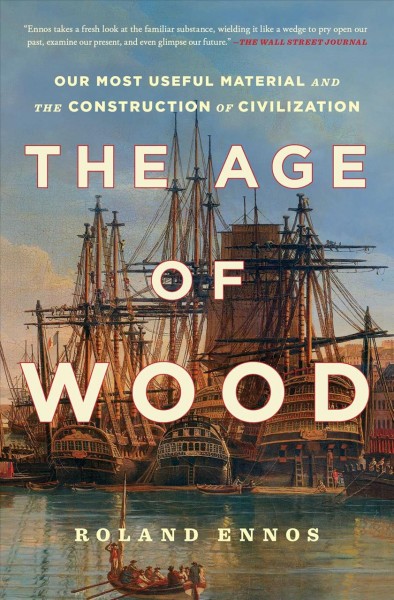
A &;smart and surprising&; (Booklist) &;expansive history&; (Publishers Weekly) detailing the role that wood and trees have played in our global ecosystem&;including human evolution and the rise and fall of empires&;in the bestselling tradition of Yuval Harari&;s Sapiens and Mark Kurlansky&;s Salt.
As the dominant species on Earth, humans have made astonishing progress since our ancestors came down from the trees. But how did the descendants of small primates manage to walk upright, become top predators, and populate the world? How were humans able to develop civilizations and produce a globalized economy? Now, in The Age of Wood, Roland Ennos shows for the first time that the key to our success has been our relationship with wood.
&;A lively history of biology, mechanics, and culture that stretches back 60 million years&; (Nature) The Age of Wood reinterprets human history and shows how our ability to exploit wood&;s unique properties has profoundly shaped our bodies and minds, societies, and lives. Ennos takes us on a sweeping journey from Southeast Asia and West Africa where great apes swing among the trees, build nests, and fashion tools; to East Africa where hunter gatherers collected their food; to the structural design of wooden temples in China and Japan; and to Northern England, where archaeologists trace how coal enabled humans to build an industrial world. Addressing the effects of industrialization&;including the use of fossil fuels and other energy-intensive materials to replace timber&;The Age of Wood not only shows the essential role that trees play in the history and evolution of human existence, but also argues that for the benefit of our planet we must return to more traditional ways of growing, using, and understanding trees.
A brilliant blend of recent research and existing scientific knowledge, this is an &;excellent, thorough history in an age of our increasingly fraught relationships with natural resources&; (Kirkus Reviews, starred review).