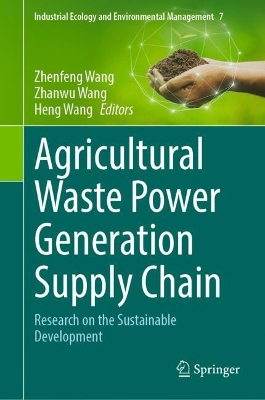
This book, titled "Research on the Sustainable Development of Agricultural Waste Power Generation Supply Chain," focuses on examining contemporary trends, challenges, and the significance of sustainable development in the management and energy generation from agricultural waste. The aims and scope of this work are outlined as follows:
1. Promoting the resourceful utilization of agricultural waste. The book seeks to facilitate the transition of agricultural waste from being perceived merely as "waste" to valuable resources by conducting comprehensive research into its energy utilization technologies, thereby enhancing both its economic value and social benefits.
2. Strengthening supply chain construction and management: This volume investigates the construction and management aspects of the supply chain related to agricultural waste collection, storage, transportation, pre-processing, transformation, and product sales. It includes optimization strategies for supply chain nodes, reduction in logistics costs, identification and mitigation of supply chain risks, selection of supply nodes, optimization of supply networks, coordination within the supply chain framework, and model selection for effective supply chains.
3. Providing theoretical support and decision-making foundations: This book compiles successful case studies and advanced practices regarding agricultural waste power generation utilization both domestically and internationally; it analyzes existing problems and challenges while offering theoretical support along with decision-making frameworks for governments, enterprises, and research institutions.
4. Evaluating sustainable development: The text establishes a comprehensive evaluation index system aimed at assessing sustainability within the agricultural waste power supply chain across multiple dimensionseconomic viability, environmental impactand societal implications while proposing improvement measures alongside optimization recommendations.
5. Enhancing public awareness: This publication aims to elevate public understanding regarding agricultural waste power generation while fostering greater awareness about environmental protection initiatives as well as sustainable development principles.
.- 1 Overview of the Agricultural Waste Power Generation Supply Chain.
.- 2 Research on Node Site Selection of Agricultural Waste Power Generation
Supply Chain.
.- 3 Agricultural waste power generation supply chain network optimization.
.- 4 Agricultural waste power generation supply chain synergistic development
research.
.- 5 Research on supply chain risk control for agricultural waste power
generation.
.- 6 Emergy analysis of agricultural waste power generation supply chain.
.- 7 Research on the revenue coordination of agricultural waste power
generation supply chain.
.- 8 Sustainability evaluation of agricultural waste power generation supply
chain.
.- 9 Policy Research on the Sustainable Development of Agricultural Waste
Power Supply Chain.
.- 10 Research on the sustainable development of agricultural waste power
generation supply Chain based on FCM.
Zhenfeng Wang is a professor and Deputy Dean of the College of Mechanical and Electrical Engineering at Henan Agricultural University, where he has long been engaged in interdisciplinary research and practice at the intersection of agricultural engineering and management. His research is closely aligned with China's national "dual carbon" strategy, with a focus on the resource recovery of agricultural waste, sustainable supply chain development, supply chain optimization, and logistics management. He specializes in applying multi-attribute decision-making methodologies to address complex technological selection challenges in agricultural waste vaporization. To address persistent challenges such as the dispersed availability of agricultural waste, high collection costs, and low transportation efficiency, he has developed systematic and scalable solutions that significantly improve resource utilization efficiency and overall system sustainability. As the academic leader in agricultural product logistics technology, Professor Wang actively advances the efficient utilization of biomass resources and the establishment of green supply chain systems, contributing essential theoretical foundations and practical pathways to support the green transformation of agriculture and the high-value utilization of agricultural byproducts.
Wang Zhanwu is doctor at the College of Mechanical and Electrical Engineering, Henan Agricultural University. He has long been engaged in research in the cross-field of agricultural engineering and logistics management. His core research direction is the sustainable development of agricultural waste resource utilization systems, focusing on the key technical bottlenecks in the integration of agriculture and sustainable development. His research is centered around the agricultural waste supply chain system, covering areas such as life cycle assessment, sustainability evaluation, supply chain optimization, and system simulation. He is skilled in using multi-attribute decision-making methods to solve complex decision-making problems in supply chains and conducts research on risk identification and control in the process of agricultural waste resource utilization by combining system dynamics models. Through the construction of mathematical models and methodological innovations, he has provided important theoretical support and technical backing for the sustainable development of the agricultural waste power generation supply chain.
Wang Heng is a professor at the College of Mechanical and Electrical Engineering of Henan Agricultural University. He has long been dedicated to research in the intersection of agricultural engineering and transportation, with a core focus on logistics system optimization. He is particularly interested in the key technical challenges in the integrated development of agriculture and transportation. His research covers areas such as agricultural product logistics, supply chain optimization, transportation system optimization and simulation, and transportation engineering, closely aligning with the practical needs of enhancing industrial circulation efficiency and promoting coordinated development in transportation. Proficient in applying intelligent optimization algorithms, he excels in solving complex issues such as optimizing agricultural product logistics routes and planning and designing transportation networks, providing customized solutions that balance cost minimization and operational efficiency for logistics enterprises and agricultural business entities. Through the integrated application of algorithm innovation and system simulation technology, he provides strong technical support for building an efficient, stable, and intelligent agricultural logistics system, effectively promoting the upgrading of the agricultural industry and the intensive and efficient utilization of transportation resources.