Muutke küpsiste eelistusi

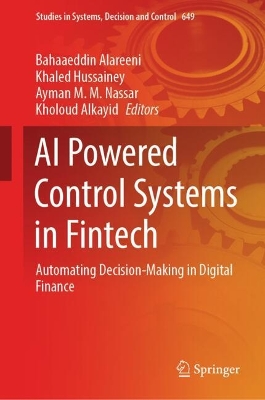
AI Powered Control Systems in Fintech: Automating Decision-Making in Digital Finance [Multiple-component retail product]

Edited by , Edited by , Edited by , Edited by
  • Formaat: Multiple-component retail product, 1158 pages, kõrgus x laius: 235x155 mm, 158 Illustrations, color; 41 Illustrations, black and white, 2 Items, Contains 2 hardbacks
  • Sari: Studies in Systems, Decision and Control
  • Ilmumisaeg: 15-May-2026
  • Kirjastus: Springer Nature Switzerland AG
  • ISBN-10: 3032131189
  • ISBN-13: 9783032131188
Teised raamatud teemal:
  • Multiple-component retail product
  • Hind: 206,62 €*
  • * hind on lõplik, st. muud allahindlused enam ei rakendu
  • Tavahind: 275,49 €
  • Säästad 25%
  • See raamat ei ole veel ilmunud. Raamatu kohalejõudmiseks kulub orienteeruvalt 3-4 nädalat peale raamatu väljaandmist.
  • Kogus:
  • Lisa ostukorvi
  • Tasuta tarne
  • Tellimisaeg 2-4 nädalat
  • Lisa soovinimekirja
  • Formaat: Multiple-component retail product, 1158 pages, kõrgus x laius: 235x155 mm, 158 Illustrations, color; 41 Illustrations, black and white, 2 Items, Contains 2 hardbacks
  • Sari: Studies in Systems, Decision and Control
  • Ilmumisaeg: 15-May-2026
  • Kirjastus: Springer Nature Switzerland AG
  • ISBN-10: 3032131189
  • ISBN-13: 9783032131188
Teised raamatud teemal:
This book explores how AI-driven control systems are transforming decision-making in fintech and digital finance. It examines the automation of financial operations, risk management, and predictive analytics, offering cutting-edge insights into the integration of AI, control theory, and financial technology. As digital finance evolves, traditional decision-making processes are rapidly becoming obsolete. AI-powered control systems now drive algorithmic trading, fraud detection, credit scoring, and regulatory compliance. This book explains the methodologies behind these advancements, covering reinforcement learning in trading, AI-driven risk assessment, and blockchain-based financial automation. Readers will gain a deep understanding of how fintech companies, banks, and financial institutions leverage AI to enhance efficiency and security. With growing market complexity, AI-driven control systems are essential for maintaining accuracy and stability in financial operations. Bridging theory and application, this book equips professionals, researchers, and business leaders with the knowledge to navigate the future of fintech. It is an essential resource for fintech innovators, AI engineers, financial analysts, and academics exploring the intersection of artificial intelligence and finance.
AI-Driven Knowledge Ecosystems in Academic Libraries: Enhancing Food
Security, Innovation, and Policy Through Digital Transformation.- How can a
fine arts company use user-generated content to enhance its digital presence?
The Case of VIARCO.- Semi-Supervised Pneumonia Detection via Contrastive
Representation Learning: A SimCLRv2 Framework with Knowledge Distillation.-
Enhancing the ability to learn English for tourism ma-jors through AI and
VR360 technology.- Innovative Education Practices for Society 5.0: Bridging
Human Potential and Technological Advancement.- Educating Employees, Not
Entrepreneurs: A Critical Analysis of Entrepreneurial Skills Development in
State Universities and Colleges.- Summarizing multi-aspect label opinions
based on the information synthesis model.- Who Cares about Location of an
Earthquake Logistics-Base in Dhaka City (Bangladesh)? An Application of
Center of Gravity Method (COG).- The Impact of Remote Working on HR
Strategies in Ensuring Employee Engagement and Performance in the UK.- The
impact of digital transformation on Nigeria-based agricultural
micro-enterprises in improving customer experience.- The Effect of Heuristic
Bias and Investment Decisions Mediated by Overconfidence, Mediation, And
Disposition Effects.- The Influence of Corporate Culture and Knowledge
Management on Employees Digital Maturity at PT East-West Seed Indonesia.-
Work Values, Organizational Commitment and Attitudes towards Quiet-Quitting
of the Multi-Generational Workforce: A Preliminary Study with a Qualitative
Approach to Employer Branding.- The Influence of Flexible Working
Arrangements and Job Satisfaction on Employee Performance at Timedoor
Indonesia.- Forecasting Indonesian Batik Export Values to the US, Japan, and
Germany in 2045: A Comparative Study of LSTM and ARIMA Models.- Smart
Training to Smart Teaching: Personalization of the Faculty Development with
the Aid of AI: The Era of Digital Education.- The Role of Push and Pull
Factors in Digital Marketing to Influence Umrah Tourists' Behavior Intentin
in Indonesia.- Technology Adoption and Digital Agility as Drivers of
Transformation: A Conceptual Exploration Across Firm Types.