Muutke küpsiste eelistusi

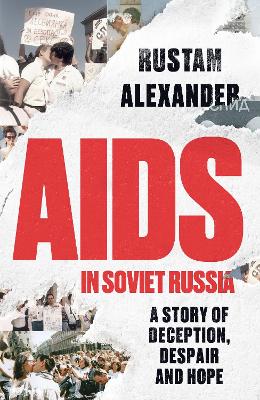
AIDS in Soviet Russia: A story of deception, despair and hope [Kõva köide]

  • Formaat: Hardback, 240 pages, kõrgus x laius x paksus: 234x156x21 mm, kaal: 619 g, 12 colour illustrations
  • Ilmumisaeg: 03-Feb-2026
  • Kirjastus: Manchester University Press
  • ISBN-10: 1526185326
  • ISBN-13: 9781526185327
  • Kõva köide
  • Hind: 22,91 €*
  • * hind on lõplik, st. muud allahindlused enam ei rakendu
  • Tavahind: 28,64 €
  • Säästad 20%
  • Raamatu kohalejõudmiseks kirjastusest kulub orienteeruvalt 3-4 nädalat
  • Kogus:
  • Lisa ostukorvi
  • Tasuta tarne
  • Tellimisaeg 2-4 nädalat
  • Lisa soovinimekirja
  • Formaat: Hardback, 240 pages, kõrgus x laius x paksus: 234x156x21 mm, kaal: 619 g, 12 colour illustrations
  • Ilmumisaeg: 03-Feb-2026
  • Kirjastus: Manchester University Press
  • ISBN-10: 1526185326
  • ISBN-13: 9781526185327
This is the first book to chronicle the history of AIDS in Soviet Russia, detailing the government’s denial of the epidemic, its cynical disinformation campaigns, and the human cost of its indifference.

The first book to tell the shocking story of the AIDS crisis in Soviet Russia.

Throughout the 1980s, as the world was grappling with the escalating crisis of AIDS, Soviet Russia continued to deny there was a problem. Arguing that the disease was limited to foreigners and ‘immoral’ groups, the government failed to take meaningful action, long past the point other countries had begun to recognise the full scale of the threat.

In this ground-breaking book, Rustam Alexander tells the story of AIDS in Soviet Russia. Fixated on disinformation, censorship and the persecution of marginalised communities, the Soviet authorities wasted precious time, allowing the epidemic to strike at the very heart of the nation: its children. Yet, despite the government’s failure, a number of brave journalists, doctors and nascent gay groups decided to take matters into their own hands and engage in full-fledged AIDS activism.

Tracing the political and social response to AIDS in the final years of the Soviet era, Alexander sheds light on the devastating consequences of government inaction. He draws on personal stories, media reports and archival materials to provide a riveting account of the Russian people’s fight against AIDS amid the tumultuous transformations of Gorbachev’s perestroika.

Arvustused

'A profoundly shocking exposé of how Soviet and Russian state ignorance, misinformation, prejudice and cover-ups created an HIV/AIDS crisis of catastrophic proportions.' Peter Tatchell, LGBT+ and human rights campaigner

Rustam Alexander situates his fascinating and detailed history of the AIDS epidemic in Russia within a deep understanding of the events leading to the collapse of the Soviet Union. His account of an often overlooked part of the global AIDS story is an important addition to scholarship on both Soviet and HIV history. Dennis Altman, author of Homosexual: Oppression and Liberation

With clarity, nuance and remarkable humanity, Alexander exposes the struggles to counter the transmission of HIV, disinformation and fear during the Soviet Unions twilight years. Though tragic and shocking, this riveting book also offers a message of hope by highlighting the activists who fought against institutional apathy and widespread stigma. Richard A. McKay, author of Patient Zero and the Making of the AIDS Epidemic

Churchill described Russia as a riddle wrapped in a mystery inside an enigma. Rustam Alexanders book lifts the veil around the early AIDS pandemic in the country. Essential reading for students of contemporary Russian history, public health and epidemiology, it is a stark warning of the failure of interventions. Alan Whiteside, author of HIV/AIDS: A Very Short Introduction

Impeccable scholarship combined with an extraordinary depth of research. AIDS in Soviet Russia is an essential record of events told concurrently with the unravelling of the Soviet empire and outlining the appalling failures, neglect and violations of human rights inherent within that derelict and corrupt system. A master work. Derek Frost, author of Living and Loving in the Age of AIDS

'Rustam Alex­an­ders new book provides a pre­his­tory of todays crisis and opens a fas­cin­at­ing win­dow on the med­ical estab­lish­ment, polit­ical elites and, espe­cially, soci­ety of Rus­sia in the 1980s.' Kristin Roth-Ey, BBC History Extra

'Alexanders straightforward narrative, largely based on Soviet press coverage, chronicles the spread of AIDS in the Soviet Union from the late 1980s, when the first cases of HIV infection were registered, up to the countrys dissolution in 1991.' Foreign Affairs -- .

Part I: Deception
1 A mysterious disease
2 HIV/AIDS at the World Youth Festival
3 The disinformation campaign takes off
Part II: Despair
4 AIDS comes to the USSR
5 'Risk groups' at the centre of public attention
6 Ignorance, injustice and the struggle for compassion
7 The first death and the failing healthcare system
Part III: Hope
8 Out of syringes, out of time?
9 Fighting AIDS in perestroikas shadow
10 The birth of Soviet queer activism
11 Resistance amid the Soviet collapse
12 After the fall, the struggle continues
Epilogue
Index -- .
Rustam Alexander is a researcher who specialises in Russian and Soviet history. He is the author of Red Closet: The Hidden History of Gay Oppression in the USSR (2023), Gay Lives and Aversion Therapy in Brezhnevs Russia (2023) and Regulating Homosexuality in Soviet Russia, 195691: A Different History (2021). His work has appeared in Slavic Review, Russian History, Europa-Asia Studies and Kritika. He is a columnist for Novaya Gazeta Evropa, an independent Russian newspaper. -- .