Muutke küpsiste eelistusi

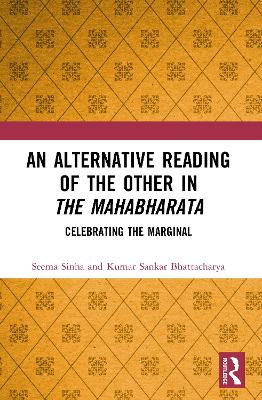
Alternative Reading of the Other in The Mahabharata: Celebrating the Marginal [Pehme köide]

  • Formaat: Paperback / softback, 190 pages, kõrgus x laius: 234x156 mm, kaal: 453 g
  • Ilmumisaeg: 22-Jun-2026
  • Kirjastus: Routledge India
  • ISBN-10: 1032988274
  • ISBN-13: 9781032988276
Teised raamatud teemal:
  • Pehme köide
  • Hind: 48,81 €*
  • * hind on lõplik, st. muud allahindlused enam ei rakendu
  • Tavahind: 65,09 €
  • Säästad 25%
  • See raamat ei ole veel ilmunud. Raamatu kohalejõudmiseks kulub orienteeruvalt 3-4 nädalat peale raamatu väljaandmist.
  • Kogus:
  • Lisa ostukorvi
  • Tasuta tarne
  • Tellimisaeg 2-4 nädalat
  • Lisa soovinimekirja
  • Formaat: Paperback / softback, 190 pages, kõrgus x laius: 234x156 mm, kaal: 453 g
  • Ilmumisaeg: 22-Jun-2026
  • Kirjastus: Routledge India
  • ISBN-10: 1032988274
  • ISBN-13: 9781032988276
Teised raamatud teemal:
This book studies gender, sexuality, and representation in The Mahabharata. Drawing on Feminist theory, Queer theory and Deconstructivist theory, it revisits the epic as a saga of agency, empowerment, and subversion, and examines how it gives the gendered marginal the women and the queer a voice.

The authors argue that in a fluid text like The Mahabharata, there is ample scope for contradiction and conformation, as well as conflict and resolution, which gives the marginal an opportunity to document resistance. They analyse the stories of Draupadi, Kunti, Renuka, Ulupi, and Hidimba within an anti-patriarchal, non-normative, post-modern theoretical framework. They also examine liminal figures like Shikhandi, Yuvanashwa, Sudyumna and Bhangashwan, who are uniquely placed in conversation involving queer space, marginalization, and resistance.

An important addition to the study of Indian epics, this book will be indispensable for scholars and researchers of cultural studies, subaltern studies, Indian literature, English literature, gender studies, sexuality studies, queer studies, womens studies, exclusion studies, and postcolonial studies.
1. INTRODUCTION
2. THE CROCODILIAN FEMALES OF THE NARI TIRTHA
3.
RENUKA AND AHALYA WHO LUSTED AFTER OTHER MEN
4. THE WILD WOMEN OF THE
MADRAKAS AND THE BALHIKAS
5. ULUPI, THE WARRIOR PRINCESS OF THE NAGAS
6.
CHITRANGADA, THE ANDROGYNOUS QUEEN OF MANIPUR
7. HIDIMBA, THE DEMON-BRIDE OF
BHIMA
8. YUVANASHWA, THE PREGNANT KING
9. SHIKHANDI, THE TRANSGENDER PRINCE
OF PANCHALA
10. YOGINI SULABHA WHO CHALLENGED KING JANAKA
11. VIDULA, THE
FIREBRAND QUEEN MOTHER
12. KUNTI: THE MOTHER OF KARNA
13. KRISHNAA DRAUPADI:
IN HER WILL RISE MANY FEARS!
14. CONCLUSION
Seema Sinha is Post-Doctoral Research Fellow, Department of Humanities and Social Sciences, BITS Pilani, Pilani Campus, Rajasthan, India.

Kumar Sankar Bhattacharya is Associate Professor, Department of Humanities and Social Sciences BITS Pilani, Pilani Campus, Rajasthan, India.