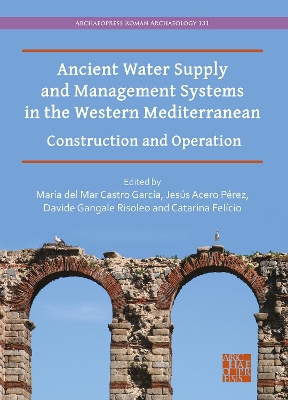
Ancient Water Supply and Management Systems in the Western Mediterranean brings together a wide range of approaches dealing with the connection between settlements and water from the Iron Age to the Late Antique period. It focuses on different infrastructures built to collect and control water from various sources: groundwater, rainwater and surface water. Vital to both human survival and a plethora of crafts and social activities, ensuring a steady supply of quality water was paramount to any settlement in Antiquity. Conversely, an excess of water also entailed drawbacks and, eventually, dangers, leading to the creation of drainage systems. Some of these systems were designed at the same time as the settlements themselves, whilst others are the result of needs that evolved over time. Collectively, these structures aimed to harness naturally occurring waters and greatly transformed the landscape. The contributions that make up this volume, coming from Portugal, Spain, France and Italy, include spatial and territorial studies, and site and question-specific case studies aiming at a broader understanding of the transformative effect and relationship these settlements had with this natural resource. The features under investigation include urban water distribution and drainage systems, aqueducts, wells, cisterns and dams, alongside broader considerations on religious and operational dimensions of these infrastructures.
Introduction. Water Management in Roman Times: Continuity and
Variability in Archaeological Studies Marķa del Mar Castro Garcķa
Water Usage at Mirobriga (Castelo Velho de Santiago do Cacém, Portugal). An
Overview of the Structures of Water Supply and Distribution Catarina
Felķcio
Water Management in Calduba (Sierra Aznar, Arcos de la Frontera, Cįdiz): A
Terraced System for the Recreation of a Locus Amoenus? Isabel
Rondįn-Sevilla, José Antonio Calvillo Ardila and Lįzaro G. Lagóstena Barrios
Erogationes in the San Lįzaro Aqueduct, Mérida? The House of the
Amphitheatre Example Macarena Bustamante-Įlvarez, Elena H. Sįnchez López
and Ana M. Bejarano Osorio
Monumental Fountains with Staircases at the End of the Iron Age in Southern
Gaul Sandrine Agusta-Boularot, Marc Bouiron, Grégory Vacassy and Ghislain
Vincent
Water Management in a Roman Settlement at the Foot of the Alps: The
Waterworks of Augusta Taurinorum Davide Gangale Risoleo and Stefania Ratto
Water and the City of Veii: A Link between Mythology, Religion, Archaeology,
and History Ugo Fusco
The Underground Structures of the Theatre in Ostia: A Preliminary Study on
the Sewerage System Katerina Gottardo
The Villa Under the Lakes. Water Management of Neros Villa in Subiaco, Rome
Fabiana Tozzi
Late Antique Transformations in Water Provision, Management and Distribution
in the Thermal Bath Archaeological Park of Baiae (Bacoli, Naples) Gioconda
Di Luca
Analysing the Water Supply to Roman Artisanal and Commercial Facilities:
Pompeii as a Case Study Elena H. Sįnchez López
Rainwater Collection and Storage in the Pompeian House: Slaves at Work
Gemma Jansen
Abellinum and its Water Distribution System: New Evidence for a Wider
Comprehension of the Hydraulic Infrastructures Marina Covolan and Daniela
Musmeci
Domesticating Water: Some Conclusions on Water Infrastructure in the
Ancient World Jesśs Acero Pérez
Marķa del Mar Castro Garcķa, PhD at the University of Cįdiz, is a Ramón y Cajal postdoctoral researcher at the Department of Prehistory and Archaeology, University of Granada. Her research interests include Roman water management, landscape archaeology, GIS analysis, and remote sensing.
Jesśs Acero Pérez, PhD in History at the University of Extremadura, has been a postdoctoral researcher, first at the Centre for Archaeology of the University of Lisbon (UNIARQ) and, since 2021, at the Department of Prehistory and Archaeology of the University of Seville. His scientific interests focus on urban planning, architecture, hydraulic engineering and waste management in Roman and Late Antiquity.
Davide Gangale Risoleo is an archaeological officer for the Ministry of Culture, working in the ABAP Superintendency for the provinces of Catanzaro and Crotone. He holds a PhD in Ancient Sciences and Archaeology from the University of Pisa and has been a research fellow at the University of Calabria. His research interests focus on the tradition of ancient topographical studies, with particular emphasis on the analysis of the relationship between water and urbanism.
Catarina Felķcio, Archaeologist and Pre-Doctoral Researcher at CHAM - Centre for the Humanities/NOVA FCSH, works on Roman Architecture and Construction, focusing mainly on bath buildings, hydraulic architecture and sanitation.