Muutke küpsiste eelistusi

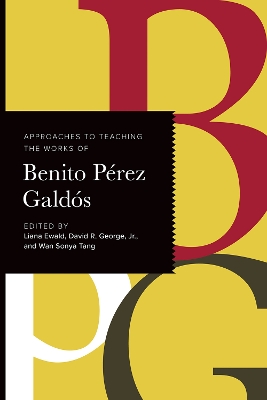
Approaches to Teaching the Works of Benito Pérez Galdós [Kõva köide]

Edited by , Edited by , Edited by
  • Formaat: Hardback, 194 pages, kõrgus x laius: 229x152 mm
  • Sari: Approaches to Teaching World Literature
  • Ilmumisaeg: 20-Mar-2026
  • Kirjastus: Modern Language Association of America
  • ISBN-10: 1603297243
  • ISBN-13: 9781603297240
  • Formaat: Hardback, 194 pages, kõrgus x laius: 229x152 mm
  • Sari: Approaches to Teaching World Literature
  • Ilmumisaeg: 20-Mar-2026
  • Kirjastus: Modern Language Association of America
  • ISBN-10: 1603297243
  • ISBN-13: 9781603297240
Essays on teaching the Spanish author Benito Pérez Galdós

The Spanish author Benito Pérez Galdós (18431920) produced an immense oeuvre of novels, stories, plays, and journalism that addressed the political, social, and aesthetic questions of his time. This volume will give any instructor interested in teaching Galdós, including those who want to teach the works in translation, exciting ways of exploring his writing with their students.

Galdós's concerns included the emergence of feminism, religion's power, the rising middle class, Spain's declining empire, increasing autocracy, and social conflict. Some essays in this volume discuss more familiar works, such as Marianela and Tristana, whereas others introduce little-known texts. Some approaches are designed for students new to textual analysis and others for students who are eager for theoretical frameworks, including food studies, medical humanities, adaptation studies, celebrity studies, and activities such as theater games and microblogging. From literary history to cultural studies, this volume's subjects are appropriate for courses in diverse settings and disciplines.

This volume contains discussion of the following works by Galdós: "El cólera y la política," La desheredada, Doña Perfecta, Electra, "La especulacion del miedo," Fortunata y Jacinta, Marianela, "Precauciones sanitarias," Tormento, Torquemada en la hoguera, Tristana, and "Tropiquillos." It also discusses Galdós adaptations and tributes such as the graphic novels 1892, by Antonio Becerra Bolaños and Alberto Hernández Rivero, and Nela, by Rayco Pulido Rodríguez; the telefilm Prim, el asesinato de la calle del Turco, written by Nacho Faerna and Virginia Yagüe; and the film Doña Perfecta, directed by Alejandro Galindo.
Introduction, by Liana Ewald, David R. George, Jr., and Wan Sonya Tang

Part One: Materials

Editions

Translations

Instructor Resources

Multimedia Resources

Part Two: Approaches

Galdos and His World

"¿Dónde vas con el mantón de Manila?": A Material Culture Approach to
Fortunata y Jacinta, by David R. George, Jr.

A Food Studies Approach to Social Class in Galdós, by Sara Muñoz-Muriana

Medical Knowledge and Debate in the Novels of Galdós, by Erika M. Sutherland

Galdós and Gender

Teaching the Woman Question through Selections from Galdós's Tristana, by
Gabrielle Miller

Galdós's Portrayals of Masculinity in Tormento, by Collin McKinney

The Rebranding of Don Juan Tenorio as Social Misfit in Tristana, by Brian
Cope

Marianela and Tristana: Lessons on Disability, Medicine, and Gender, by Julia
Haeyoon Chang

Galdós beyond the Novel

Teaching Contagion, Politics, and Epistemology through Galdós's Fiction and
Journalism, by Erika Rodríguez

Gothic Galdós: Unsettling Spanish Imperialism in "Tropiquillos," by Wan Sonya
Tang

Galdós as Celebrity Playwright, by Margot Versteeg

The Author Is a Character: Fictional Embodiments of Galdós in the
Twenty-First Century, by Elena Cueto Asín

Galdós in Adaptation

Teaching Marianela: From Galdós's Novel to Pulido's Graphic Novel, by Linda
M. Willem

Transatlantic Adaptations: Teaching Doña Perfecta through Alejandro Galindo's
Film, by Luis Álvarez-Castro

Teaching Galdós through Film Adaptations and Filmmaking, by Rhian Davies

Galdós in Practice

Reading Pretty Privilege in Marianela, by Lennie Amores

Orienting Bodies in Electra: Teaching Galdós through History and Embodiment,
by Laurie Lomask

Meeting Galdós through Open Pedagogy, by Juan Jesús Payán and Robin R.
Miller

Tweeting Tristana: Bringing the Literature Classroom Online through
Microblogging, by Stacy L. Davis

Notes on Contributors

Survey Respondents

Works Cited