Muutke küpsiste eelistusi

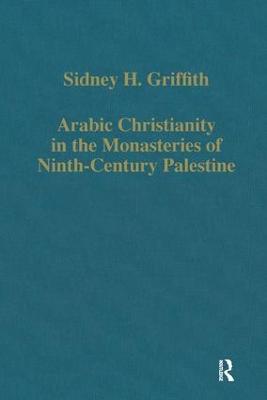
Arabic Christianity in the Monasteries of Ninth-Century Palestine [Kõva köide]

  • Formaat: Hardback, 352 pages, kõrgus x laius: 224x150 mm, kaal: 810 g
  • Sari: Variorum Collected Studies
  • Ilmumisaeg: 20-Aug-1992
  • Kirjastus: Variorum
  • ISBN-10: 0860783375
  • ISBN-13: 9780860783374
  • Kõva köide
  • Hind: 159,19 €*
  • * hind on lõplik, st. muud allahindlused enam ei rakendu
  • Tavahind: 212,25 €
  • Säästad 25%
  • Raamatu kohalejõudmiseks kirjastusest kulub orienteeruvalt 3-4 nädalat
  • Kogus:
  • Lisa ostukorvi
  • Tasuta tarne
  • Tellimisaeg 2-4 nädalat
  • Lisa soovinimekirja
  • Raamatukogudele
  • Formaat: Hardback, 352 pages, kõrgus x laius: 224x150 mm, kaal: 810 g
  • Sari: Variorum Collected Studies
  • Ilmumisaeg: 20-Aug-1992
  • Kirjastus: Variorum
  • ISBN-10: 0860783375
  • ISBN-13: 9780860783374
The history of Christian literature took a new turn in the 8th century when monks in the monasteries of Palestine began to write theology and saints lives in Arabic; they also instituted a veritable programme for translating the Bible and other Christian texts from Greek (and Syriac) into the language of the Quran, the lingua franca of the Islamic caliphate. This is the subject of the present volume. Two key factors leading to this change, as Professor Griffith indicates, were that the confrontation with the developing theology of Islam created a direct need for apologetics to face this new religious challenge in its own language; and, second, simply that as the memory of Byzantine power waned, so too did the knowledge of Greek. Issues of particular interest in this apologetic literature are those of the freedom of the will, a key topic in the controversies between Melkites and Muslims, and of the legitimacy of icon veneration, a subject of great contemporary concern at the time of Iconoclasm in the Byzantine Empire. Lhistoire de la littérature chrétienne a pris un nouveau tournant au 8 siécle lorsque les religieux des monastères de Palestine commencèrent à écrire la théologie et la vie des saints en arabe. De même, ils instituèrent un véritable programme de traduction de la Bible et autres textes chrétiens du grec (et du syriaque) en langue corannique, la lingua franca du califat islamique. Tel est lobjet du présent recueil. Deux facteurs determinants ayant conduit à ce changement, comme lindique le professeur Griffith, étaient, en premier lieu, la confrontation avec une théologie islamique croissante, qui créait un besoin pressant pour les apologétiques de faire face à ce nouveau défi religieux dans la langue propre à celui-ci; en second lieu, au fur et à mesure que sestompait la mémoire du pourvoir byzantin, il en allait de même pour la connaissance que lon avait de la langue grecque. Ces textes traitent de q

Arvustused

'...the book is a valuable contribution towards understanding Eastern Christianity in the Arab world.' Muslim World Book Review, No 4

Contents: Preface; The prophet Muhammad, his scripture and his message,
according to the Christian apologies in Arabic and Syriac from the first
Abbasid century; The Gospel in Arabic: an inquiry into its appearance in the
first Abbasid century; The monks of Palestine and the growth of Christian
literature in Arabic; Eutychius of Alexandria on the emperor Theophilus and
Iconoclasm in Byzantium: a 10th-century moment in Christian apologetics in
Arabic; Theodore Abu Qurrah's Arabic tract on the Christian practice of
venerating images; Free will in Christian kalam: the doctrine of Theodore Abu
Qurrah; Stephen of Ramlah and the Christian kerygma in Arabic in 9th- century
Palestine; Greek into Arabic: life and letters in the monasteries of
Palestine in the 9th century; the example of the Summa Theologiae Arabica; A
9th-century Summa Theologiae Arabica; The Arabic account of Abd al-Masih
an-Nagrani al-Ghassani; Anthony David of Baghdad, scribe and monk of Mar
Sabas: Arabic in the monasteries of Palestine; Additions; Index.
Sidney H. Griffith Catholic University of America, USA