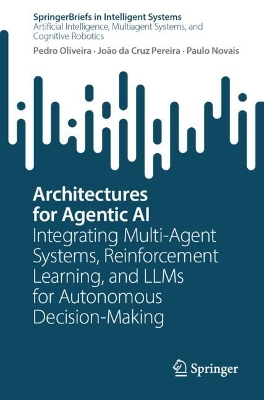
This book explores the emerging paradigm of Agentic AI, where Large Language Models (LLMs) and Reinforcement Learning (RL) converge to create intelligent, autonomous, and adaptive systems. It provides a unified theoretical foundation and connects it to practical implementation, offering readers a clear path from concept to execution. It will also provide an integrative approach of Agentic AI, Large Language Models, and Reinforcement Learning. While these topics are often studied separately, this book provides a coherent framework that unites them, filling a critical gap between AI theory, system design, and real-world application.
In an era of rapidly evolving AI technologies, understanding how Agentic AI systems operate, and how they differ from traditional AI, is essential. This book guides researchers, engineers, and AI practitioners through the architectural principles that empower agents to reason, cooperate, and learn from feedback. It further demonstrates how RL can fine-tune LLMs to produce more focused, context-aware outputs, strengthening their role in multi-agent collaboration and autonomous decision-making.
The content unfolds from the evolution of AI to Agentic AI, covering architectural design, learning mechanisms, and integration strategies for LLMs and RL. A real-world case study anchors the theory in practice, illustrating how these technologies can be combined to build interpretable systems. Readers will discover adaptive orchestration strategies, methods for enhancing model interpretability, and design templates for developing intelligent agent ecosystems. By the end, readers will not only understand the inner workings of Agentic AI but also gain the tools to design and implement their own agent-based frameworks. A working knowledge of Python is recommended to fully engage with the practical aspects.
Foreword.- Preface.- Acknowledgements.- Contents.- Acronyms.-
1. From
Classical AI to Agentic Intelligence.-
2. Theoretical Foundations of Agentic
AI.-
3. Architectural Design Principles.-
4. Language-Based Interpretability
in Agentic Systems.-
5. Learning and Adaptation in Agentic AI.-
6. Practical
Application of the Case Study.-
7. Conclusion.
Dr. Pedro Oliveira obtained his PhD from the School of Engineering of the University of Minho, Braga, Portugal, and works as a researcher at the ALGORITMI Centre, in the Synthetic Intelligence Lab (ISLAB) research group. He holds a MSc degree in Informatics Engineering from the same university, where from his position as Invited Professor he teaches classes on Multi-Agent Systems, Data Engineering and applications of Machine and Deep Learning models. His research interests include Recurrent Neural Networks, where models such as Long Short-Term Memory or Gated Recurrent Unit are applied in the context of Time Series Problems. He also uses these to detect anomalies in different systems applied in the same context as before. Recently, he has started to investigate frameworks that incorporate Multi-Agent Systems connected to Reinforcement Learning, particularly Agentic AI.
Joćo da Cruz Pereira is a MSc student in Computer Engineering at the School of Engineering of the University of Minho, Braga, Portugal. He is also a scholarship holder at the ALGORITMI Centre, in the Synthetic Intelligence Lab (ISLAB) research group. He is employed at the same University as an Invited Professor, teaching classes on Artificial Intelligence, particularly on Symbolic AI, Data Science and the use of Machine and Deep Learning models. The focus of his interest areas is Image Classification, namely the classification of Water Quality by using Remote Sensing techniques such as Satellite Imagery, as well as the inclusion of Large Language Models to introduce interpretability to the different frameworks created to help in decision making.
Paulo Novais is a Full Professor of Computer Science at the Department of Informatics, the School of Engineering, the University of Minho (Portugal) and a researcher at the ALGORITMI Centre, where he leads the research group Synthetic Intelligence Lab, and coordinates the Computer Science and Technology (CST) research line. He is the director of the PhD Program in Informatics and co-founder and Deputy Director of the Master in Law and Informatics at the University of Minho. He started his career developing scientific research in the field of Intelligent Systems/Artificial Intelligence (AI), namely in Knowledge Representation and Reasoning, Machine Learning and Multi-Agent Systems. His interest in the last years was absorbed by the different, yet closely related, concepts of Ambient Intelligence/Ambient Assisted Living, Conflict Resolution, Behavioral Analysis, Intelligent Tutors and the incorporation of AI methods and techniques in these fields. His main research aim is to make systems a little smarter, intelligent and also reliable. He is the co-author of over 450 book chapters, journal papers, conference and workshop papers and books. He was President of General Assembly and Former President of APPIA (the Portuguese Association for Artificial Intelligence) between 2016 and 2019, Senior member of the IEEE (Institute of Electrical and Electronics Engineers), member of the IFIP (International Federation for Information Processing) - TC 12 Artificial Intelligence and of the executive committee of the IBERAMIA (IberoAmerican Society of Artificial Intelligence), and is the Coordinator of the Scientific Committee of the Gulbenkian Scholarship Program New Talent in Artificial Intelligence of the Calouste Gulbenkian Foundation. He has served as an expert of several institutions such as the EU Commission, FCT (Portuguese agency that supports science, technology and innovation), A3ES (Agency for Assessment and Accreditation of Higher Education) and ANI (National Innovation Agency).