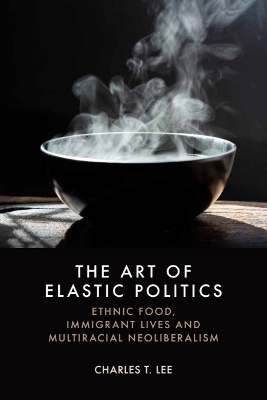
The Art of Elastic Politics: Ethnic Food, Immigrant Lives and Multiracial Neoliberalism explores how immigrant food practices inspire new ways of rethinking progressive politics in the shifting contours of neoliberal capitalism. Drawing on ethnographic fieldwork in Southern California’s Asian restaurant industry, this book develops the concept of elasticity as a theoretical framework for navigating neoliberalism’s contradictions.
By examining how the dynamic interplay of ethnic entrepreneurship, immigrant labor and cultural consumption creates subtle, nonlinear opportunities for resistance, empowerment and citizenship contestation, the book challenges conventional political frameworks through a flexible and circuitous approach to contesting precarity and inequality. Bridging political theory, cultural studies, food studies and posthumanism, this interdisciplinary study – organized around the themes of Elastic Food, Elastic Citizenship and Elastic Governance – equips scholars, activists and students with nuanced tools and frameworks for grappling with the challenges and complexities of migration, citizenship, governance and global capitalism in a rapidly evolving world.
Explores how immigrant food practices generate new political imaginaries in the shifting contours of neoliberal capitalism.
Arvustused
Using the proliferation and material culture of Asian restaurants in Southern California as a case study, this book lays out what the author calls The Art of Elastic Politics, where resistance is not simply oppositional but takes on non-linear, circuitous and elastic forms of being political in the everyday. This is a major intervention in political theory, inviting us to rethink democracy, citizenship, rights, power and governance in the era of multiracial neoliberalism. A hugely inspiring read! -- Ien Ang, Western Sydney University Bridging new materialism, ethnic studies and food studies, The Art of Elastic Politics combines political theory with ethnographic fieldwork in Asian restaurants to offer a powerful framework for understanding how power, resistance and social change operate in our interconnected, commodified world. Essential reading for how citizenship, belonging, and political change are being remade in twenty-first century America. -- Cristina Beltrįn, New York University
Acknowledgments
Introduction: Transformation Is in the Details: Ethnic Food, Immigrant lives,
and the Art of Elastic Politics in Neoliberal Times
Part I: Elastic Food
1. Strategic Posthumanism: Happy Objects, Affective Economy, and Reanimating
Citizenship Life
2. The Posthuman Politics of Happy Objects: From the Mystery of the Chinese
Chop Suey to the Renaissance of the Korean Soft Tofu Stew
Part II: Elastic Citizenship
3. Of 626 and Bobalife: Ethnoburbs, Transnational Asian Material Culture,
and Reinventing the Right to the City in the Age of Multiracial
Neoliberalism
4. Elastic Citizenship Through Asian Restaurants in SoCal: The Triangular
Improvisation of Nonexistent Rights via Ethnic Entrepreneurship, Labor, and
Consumption in Everyday Life
Part III: Elastic Governance
5. A Quasi-Sovereignty That Is Illusive but Real: Market, Civil Society, and
Toward a Left Art of Elastic Governance
6. Redesigning Reforms in the Threshold Space between Mainstream Reform and
Radical Abolition: State, Posthuman Attachment, and the Elastic Recrafting of
Rights
Bibliography
Index
Charles T. Lee is Associate Professor of Justice and Social Inquiry in the School of Social Transformation at Arizona State University. Working across the fields of political theory, cultural studies, cultural politics, and critical citizenship studies, his research explores innovative formations of political agency and cultural resistance within the global circuits of neoliberal capitalism. He is the author of Ingenious Citizenship: Recrafting Democracy for Social Change (Duke University Press, 2016), which received the 2017 Transdisciplinary Book Award from the Institute for Humanities Research at Arizona State University.