Muutke küpsiste eelistusi

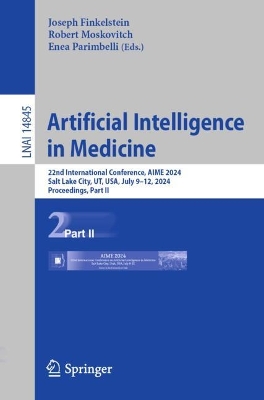
Artificial Intelligence in Medicine: 22nd International Conference, AIME 2024, Salt Lake City, UT, USA, July 912, 2024, Proceedings, Part II 2024 ed. [Pehme köide]

Edited by , Edited by , Edited by
  • Formaat: Paperback / softback, 366 pages, kõrgus x laius: 235x155 mm, 110 Illustrations, color; 11 Illustrations, black and white, 1 Paperback / softback
  • Sari: Lecture Notes in Computer Science 14845
  • Ilmumisaeg: 27-Jul-2024
  • Kirjastus: Springer International Publishing AG
  • ISBN-10: 3031665341
  • ISBN-13: 9783031665349
  • Pehme köide
  • Hind: 56,20 €*
  • * hind on lõplik, st. muud allahindlused enam ei rakendu
  • Tavahind: 74,93 €
  • Säästad 25%
  • Raamatu kohalejõudmiseks kirjastusest kulub orienteeruvalt 3-4 nädalat
  • Kogus:
  • Lisa ostukorvi
  • Tasuta tarne
  • Tellimisaeg 2-4 nädalat
  • Lisa soovinimekirja
  • Formaat: Paperback / softback, 366 pages, kõrgus x laius: 235x155 mm, 110 Illustrations, color; 11 Illustrations, black and white, 1 Paperback / softback
  • Sari: Lecture Notes in Computer Science 14845
  • Ilmumisaeg: 27-Jul-2024
  • Kirjastus: Springer International Publishing AG
  • ISBN-10: 3031665341
  • ISBN-13: 9783031665349
This two-volume set LNAI 14844-14845 constitutes the refereed proceedings of the 22nd International Conference on Artificial Intelligence in Medicine, AIME 2024, held in Salt Lake City, UT, USA, during July 9-12, 2024.


The 54 full papers and 22 short papers presented in the book were carefully reviewed and selected from 335 submissions.


The papers are grouped in the following topical sections:


Part I: Predictive modelling and disease risk prediction; natural language processing; bioinformatics and omics; and wearable devices, sensors, and robotics.


Part II: Medical imaging analysis; data integration and multimodal analysis; and explainable AI.
.- Medical imaging analysis.


.- 3T to 7T Whole Brain + Skull MRI Translation with Densely Engineered U-Net
Network.


.- A Sparse Convolutional Autoencoder for Joint Feature Extraction and
Clustering of Metastatic Prostate Cancer Images.


.- AI in Neuro-Oncology: Predicting EGFR Amplification in Glioblastoma from
Whole Slide Images using Weakly Supervised Deep Learning.


.- An Exploration of Diabetic Foot Osteomyelitis X-ray Data for Deep Learning
Applications.


.- Automated Detection and Characterization of Small Cell Lung Cancer Liver
Metastases on CT.


.- Content-Based Medical Image Retrieval for Medical Radiology Images.


.- Cross-Modality Synthesis of T1c MRI from Non-Contrast Images Using GANs:
Implications for Brain Tumor Research.


.- Harnessing the Power of Graph Propagation in Lung Nodule Detection.


.- Histology Image Artifact Restoration with Lightweight Transformer and
Diffusion Model.


.- Improved Glioma Grade Prediction with Mean Image Transformation.


.- Learning to Predict the Optimal Template in Stain Normalization For
Histology Image Analysis.


.- MRI Brain Cancer Image Detection Application of an Integrated U-Net and
ResNet50 Architecture.


.- MRI Scan Synthesis Methods based on Clustering and Pix2Pix.


.- Supervised Pectoral Muscle Removal in Mammography Images.


.- TinySAM-Med3D: A Lightweight Segment Anything Model for Volumetric Medical
Imaging with Mixture of Experts.


.- Towards a Formal Description of Artificial Intelligence Models and
Datasets in Radiology.


.- Towards Aleatoric and Epistemic Uncertainty in Medical Image
Classification.


.- Ultrasound Image Segmentation via a Multi-Scale Salient Network.


.- Data integration and multimodal analysis.


.- A 360-Degree View for Large Language Models: Early Detection of Amblyopia
in Children using Multi-View Eye Movement Recordings.


.- Enhancing Anti-VEGF Response Prediction in Diabetic Macular Edema through
OCT Features and Clinical Data Integration based on Deep Learning.


.- Expert Insight-Enhanced Follow-up Chest X-Ray Summary Generation.


.- Integrating multimodal patient data into attention-based graph networks
for disease risk prediction.


.- Integrative analysis of amyloid imaging and genetics reveals subtypes of
Alzheimer progression in early stage.


.- Modular Quantitative Temporal Transformer for Biobank-scale Unified
Representations.


.- Multimodal Fusion of Echocardiography and Electronic Health Records for
the Detection of Cardiac Amyloidosis.


.- Multi-View $k$-Nearest Neighbor Graph Contrastive Learning on Multi-Modal
Biomedical Data.


.- Quasi-Orthogonal ECG-Frank XYZ Transformation with Energy-based models and
clinical text.


.- Explainable AI.


.- Do you trust your model explanations? An analysis of XAI performance under
dataset shift.


.- Explainable AI for Fair Sepsis Mortality Predictive Model.


.- Explanations of Augmentation Methods For Deep Learning ECG
Classification.


.- Exploring the possibility of arrhythmia interpretation of time domain ECG
using XAI: a preliminary study.


.- Improving XAI Explanations for Clinical Decision-Making Physicians
Perspective on Local Explanations in Healthcare.


.- Manually-Curated Versus LLM-Generated Explanations for Complex Patient
Cases: An Exploratory Study with Physicians.


.- On Identifying Effective Investigations with Feature Finding using
Explainable AI: an Ophthalmology Case Study.


.- Towards Interactive and Interpretable Image Retrieval-Based Diagnosis:
Enhancing Brain Tumor Classification with LLM Explanations and Latent
Structure Preservation.


.- Towards Trustworthy AI in Cardiology: A Comparative Analysis of
Explainable AI Methods for Electrocardiogram Interpretation.