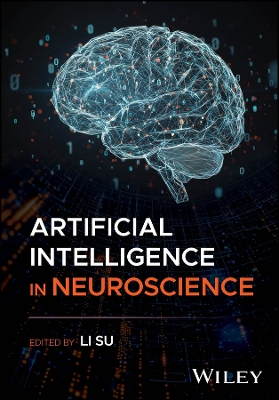
Provides comprehensive guidance on harnessing artificial intelligence for neuroscience research and clinical applications
The rapid development of artificial intelligence (AI) has created new opportunities for advancing the study of the brain. While recent scholarship has focused on how neuroscience can inform the design of AI systems, there is a growing need for resources that demonstrate how AI can be applied to support neuroscience research and practice. Artificial Intelligence in Neuroscience offers a detailed introduction to AI technologies and their transformative potential for fields ranging from neuroimaging and genetics to mental healthcare and neuro-oncology.
Structured around four major areas, the book begins by exploring the shared history of AI and neuroscience, from single-neuron modeling and action potentials to contemporary learning mechanisms. It then examines how AI can be used as a data analysis tool in genetics, proteomics, histology, cognition, and population health, before turning to clinical applications such as biologically plausible cognitive models, connectionist frameworks, and reinforcement learning. Additional chapters consider emerging applications, including robotics, drug screening, brain-computer interfaces, and language models. The volume concludes with a critical discussion of ethical and privacy issues, ensuring readers are equipped to navigate the responsibilities that accompany technological innovation.
Wide in scope and filled with practical insights, Artificial Intelligence in Neuroscience:
Explores the historical intersections between AI and neuroscience to contextualize current innovations Demonstrates applications of AI in neuroimaging, genetics, and population health research Details clinical applications of AI models, including reinforcement learning and connectionist frameworks Highlights novel uses of AI in robotics, brain-computer interfaces, and drug discovery Integrates technical depth with applied case studies for both academic and clinical contexts
Artificial Intelligence in Neuroscience is ideal for graduate students, early career researchers, and established professionals in neuroscience, psychology, computer science, and medicine. It is well-suited for courses in computational neuroscience, AI in healthcare, and neuroinformatics within advanced degree programs in neuroscience, biomedical sciences, data science, and clinical psychology.