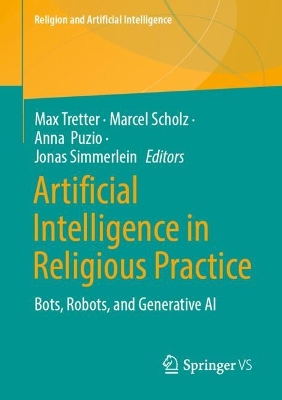
Artificial Intelligence has entered religious contexts. This edited volume focuses on AI as it is developed for religious settings and increasingly embedded in concrete religious practices. It offers an interdisciplinary and interreligious perspective on a rapidly evolving field.
Technically oriented contributions provide insights into the development of specific AI tools for religious applications and explore the technical, conceptual, and design-related challenges involved. Contributions from theology, religious studies, and ethics analyze how Artificial Intelligence is reshaping religious communication and practices, reflect on the implications of these developments, and formulate guidelines and impulses for the responsible use of AI in religious contexts.
By systematically bringing technical development into conversation with theological and ethical reflection, the volume bridges theory and practice. It is intended for researchers, students, and practitioners interested in religion in the age of Artificial Intelligence.
Chapter
1. Artificial Intelligence and religion: Closing the gaps
between theory and practice.
Chapter
2. The AI XR Martin Luther Avatar: An
experiment with theological, ethical and technological implication.
Chapter
3. Midrash.ai: Exploring generative AI for religious interpretation with the
Babylonian Talmud.
Chapter
4. Leveraging Large Language Models for pastoral
care training: Development, application, and ethical considerations of an AI
simulation chatbot.
Chapter
5. Potential and challenges of Artificial
Intelligence and robotics in religious education: An empirical exploration of
teachers perceptions.
Chapter
6. You really dont need a doctor to die:
Ethical assessment on the euthanasia device Sarco pod.
Chapter
7. Post-labor
religion? Artificial Intelligence and the reconfiguration of ministry.-
Chapter
8. Artificial Intelligence in the medical diagnostic process: Issues
of responsibility and care ethics.
Chapter
9. Morally capable AIs?
Anthropological considerations with a view to the human self-relation.-
Chapter
10. Leadership communication, authentic authorship, and the
performance paradox with efficient sermon generators.
Chapter
11. Church &
AIa contradiction? Five theses for a fearless and future-oriented approach
to Artificial Intelligence.
Dr. Max Tretter is a postdoctoral researcher at the Institute of Systematic Theology at Friedrich-Alexander-Universität Erlangen-Nürnberg. His research focuses on systematic theology, theological ethics, and public theology, as well as theological and ethical perspectives on AI.
Marcel Scholz is a research assistant in religious education at the Chair of Practical Theology/Religious Education at the Faculty of Protestant Theology at Johannes Gutenberg University Mainz. His research interests lie in Religious Education, Artificial Intelligence and Religious Education.
Dr. Anna Puzio is a philosopher, theologian, and ethicist working on the ethics of technology at the University of Bern. She is a researcher in the Ethics of Socially Disruptive Technologies programme in the Netherlands and a member of the Critical Data Lab in Berlin.
Jonas Simmerlein is an associated researcher at the Department of Protestant Theology at the University of Vienna. His research focuses primarily on religious phenomenology, AI in religious practices, and religious robotics.