Muutke küpsiste eelistusi

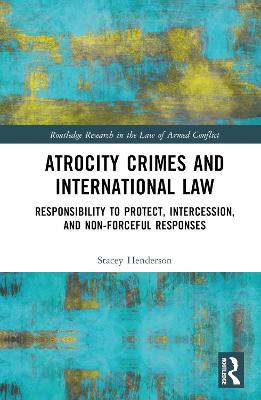
Atrocity Crimes and International Law: Responsibility to Protect, Intercession, and Non-Forceful Responses [Kõva köide]

Teised raamatud teemal:
  • Kõva köide
  • Hind: 144,00 €*
  • * hind on lõplik, st. muud allahindlused enam ei rakendu
  • Tavahind: 192,00 €
  • Säästad 25%
  • Raamatu kohalejõudmiseks kirjastusest kulub orienteeruvalt 3-4 nädalat
  • Kogus:
  • Lisa ostukorvi
  • Tasuta tarne
  • Tellimisaeg 2-4 nädalat
  • Lisa soovinimekirja
  • Raamatukogudele
Teised raamatud teemal:
This book illuminates the way in which measures of intercession, inspired by the ideals of Responsibility to Protect (R2P), have provided a solution to the dilemma of articulating when and how the international community may respond to atrocity crimes occurring in other States.

Despite repeated declarations of ‘never again’ in response to the commission of atrocities, civilians have continued to be targeted by their leaders and opposition groups. The international law principles of sovereignty and non-intervention, when taken at their highest, require States to stand idle and not intervene in another State regardless of what atrocities may be occurring there. This traditional legal view is being challenged by an emerging practice of States choosing to respond in non-forceful ways, inspired by the concept of the Responsibility to Protect. Drawing on Responsibility to Protect (R2P), this book introduces and develops an original conceptual tool – intercession – to capture and explain this change in State practice and the impact of R2P on the development of international law. Through a close examination of State practice, the work explores whether there has been an expansion in the permissible measures and situations in which States can intervene, without using force, in response to atrocity crimes occurring in other States. This book concludes that the development of the secondary duty on the international community under R2P provides the greatest opportunity to progress the R2P framework in a meaningful way, which will have a significant impact on the protection of populations from atrocity crimes. The book will be essential reading for students, researchers and policy-makers working in the areas of International Law, International Relations, Humanitarian Law, and Peace and Security Studies.

Arvustused

'Atrocity Crimes and International Law is an excellent work which is of relevance to international law, international relations, humanitarian law, and peace and security studies, offering a logical and clear argument, and supported by appropriate and persuasive case studies. The book offers insights into the emerging behaviours of States in a vital area. Henderson examines State practice in response to atrocity crimes through the prism of intercession, revealing the power of ideas to prompt change in international law and inform the advancement of the R2P framework in a meaningful way, while also powerfully countering those who continue to challenge the existence of the concept.'

Hui Li and Le Cheng, book review in International and Comparative Law Quarterly

Acknowledgements ix
1 A shield for delinquent States
1(2)
1.1 Shielding delinquent States: sovereignty and the principle of non-intervention at their highest
3(3)
1.2 Piercing the shield of sovereignty
6(6)
1.3 Implementing and operationalising R2P
12(5)
1.4 Maximising permissible responses to atrocity crimes
17(6)
2 Intercession as a conceptual tool to examine State practice
23(1)
2.1 Not a binary choice between doing nothing and using armed force
24(1)
2.2 Intercession
25(2)
2.3 Implementing R2P by using measures less than force
27(4)
2.4 The power of ideas to shape State practice
31(2)
2.5 Charting a way forward for significantly enhanced international responses to the commission of atrocity crimes
33(5)
3 The use of diplomatic measures to respond to atrocity crimes
38(18)
3.1 The use of diplomatic measures to respond to atrocity crimes
40(10)
3.2 Softening the hard edges of R2P
50(6)
4 Economic sanctions: the practice of the United Nations, regional organisations, and States
56(33)
4.1 A working definition of economic sanctions
56(1)
4.2 Legal justification for the imposition of sanctions
57(3)
4.3 Contemporary sanctions practice
60(19)
4.4 The significance of contemporary sanctions practice
79(3)
4.5 An evolving sanctions practice
82(7)
5 Restriction of means to commit atrocities
89(28)
5.1 Campaigning for regulation of the international conventional arms trade
91(1)
5.2 Progress towards the Arms Trade Treaty at the United Nations
92(3)
5.3 The relevance of R2P for the Arms Trade Treaty
95(1)
5.4 The treaty text
96(13)
5.5 State responsibility and the Arms Trade Treaty
109(2)
5.6 The restraining influence of intercession under R2P
111(6)
6 Provision of assistance to opposition groups
117(35)
6.1 The traditional approach
118(3)
6.2 Evidence of an emerging and different State practice
121(21)
6.3 A more drastic form of intercession
142(10)
7 R2F: more than empty rhetoric
152(17)
7.1 The evolution of foundational principles of international law
152(4)
7.2 Measures less than the use of force
156(1)
7.3 R2P in practice
157(6)
7.4 More than empty words
163(6)
Index 169
Stacey Henderson is a senior lecturer at the College of Business, Government and Law, Flinders University. Her research focuses on the protective capacity of law, the responsibility to protect (R2P) and the use of measures less than force to help to protect populations, and the governance of outer space and space technology.