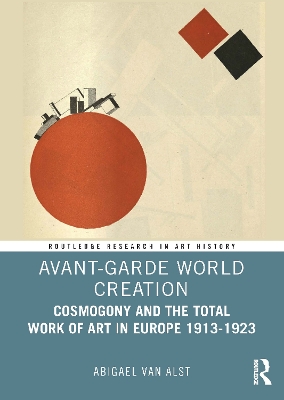
"This book explores the widespread fascination with world creation among early twentieth century artists, and examines those trends within the European avant-garde. The book reflects on what 'the world' looks and feels like before and after World War One- and thus also concerns creativity and destruction alike in the context of modernity. Over the course of three chapters, the author focusses on works in which avant-garde artists combine and experiment with various arts and media to create alternative narratives of the world's creation. These works include three canonized 'total works of Art': the Futurist Opera Victory Over the Sun (1913) by Aleksei Kruchenykh, Velimir Khlebnikov, Kazimir Malevich, and Mikhail Matiushin, Der Weltbaumeister (The World'sMaster Builder, 1920), an illustrated book imagined as an architectural play by the Experssionist Bruno Taut; and the Cubist ballet La Creation du monde (The Creation of the World, 1923) by Blaise Cendrars, Fernand Leger, Darius Milhaud, and Jean Borlin.Providing new readings of these classic works that dive deeply into the avant-garde's inter-artistic search for new modes of mediation as well as its dialogue with science, politics and technology, van Alst demonstrates how each of these artworks staged a cosmogony-an alternative story of the universe's creation-which, simultaneously, experimentally and critically recounted the story of modernity. This new book is ideal for researchers and scholars in History of Art, Modernism, and Comparative Literature"-- Provided by publisher.
This book explores the widespread fascination with world creation among early twentieth century artists, and examines those trends within the European avant-garde.
The book reflects on what ‘the world’ looks and feels like before and after World War One – and thus also concerns creativity and destruction alike in the context of modernity. Over the course of three chapters, the author focusses on works in which avant-garde artists combine and experiment with various arts and media to create alternative narratives of the world’s creation. These works include three canonized ‘total works of Art’: the Futurist Opera Victory Over the Sun (1913) by Aleksei Kruchenykh, Velimir Khlebnikov, Kazimir Malevich, and Mikhail Matiushin, Der Weltbaumeister (The World’s Master Builder, 1920), an illustrated book imagined as an architectural play by the Experssionist Bruno Taut; and the Cubist ballet La Creation du monde (The Creation of the World, 1923) by Blaise Cendrars, Fernand Leger, Darius Milhaud, and Jean Borlin. Providing new readings of these classic works that dive deeply into the avant-garde’s inter-artistic search for new modes of mediation as well as its dialogue with science, politics and technology, van Alst demonstrates how each of these artworks staged a cosmogony—an alternative story of the universe's creation—which, simultaneously, experimentally and critically recounted the story of modernity.
This new book is ideal for researchers and scholars in History of Art, Modernism, and Comparative Literature.
This book explores the widespread fascination with world creation among early twentieth century artists, and examines those trends within the European avant-garde.