Muutke küpsiste eelistusi

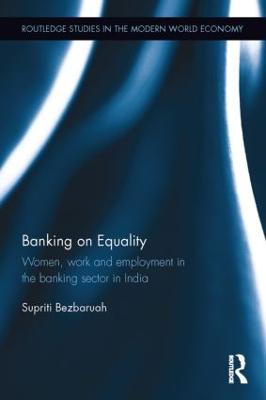
Banking on Equality: Women, work and employment in the banking sector in India [Kõva köide]

  • Formaat: Hardback, 194 pages, kõrgus x laius: 234x156 mm, kaal: 453 g, 8 Tables, black and white; 13 Illustrations, black and white
  • Sari: Routledge Studies in the Modern World Economy
  • Ilmumisaeg: 25-Mar-2015
  • Kirjastus: Routledge
  • ISBN-10: 1138778338
  • ISBN-13: 9781138778337
Teised raamatud teemal:
  • Kõva köide
  • Hind: 174,38 €*
  • * hind on lõplik, st. muud allahindlused enam ei rakendu
  • Tavahind: 232,50 €
  • Säästad 25%
  • Raamatu kohalejõudmiseks kirjastusest kulub orienteeruvalt 3-4 nädalat
  • Kogus:
  • Lisa ostukorvi
  • Tasuta tarne
  • Tellimisaeg 2-4 nädalat
  • Lisa soovinimekirja
  • Formaat: Hardback, 194 pages, kõrgus x laius: 234x156 mm, kaal: 453 g, 8 Tables, black and white; 13 Illustrations, black and white
  • Sari: Routledge Studies in the Modern World Economy
  • Ilmumisaeg: 25-Mar-2015
  • Kirjastus: Routledge
  • ISBN-10: 1138778338
  • ISBN-13: 9781138778337
Teised raamatud teemal:

It may well be surprising to say that the world should look to India as a model of gender equality. India’s banking sector proves the exception, with several women reaching the highest positions in India’s top banks, including the country’s largest bank.

Based on interviews and surveys of bank employees in India’s National Capital Region, this book looks at what lies behind the media rhetoric and provides a systematic analysis of patterns of, and responses to gender inequality in the banking sector in India. The book uncovers how gender discrimination still persists in the banking sector, albeit in covert forms. Through a comparison of nationalised, Indian private and foreign banks, the book demonstrates how the impact of laws, local cultural norms and gendered workplace practices are mediated through different organisational forms in these different types of banks to create varied experiences of gender inequality.

The book is one of the first books to provide a thorough, in-depth analysis of women’s employment in the Indian banking sector, currently an under-researched area.

List of figures
xvi
List of tables
xvii
Acknowledgements xviii
List of abbreviations
xxi
1 Introduction
1(15)
2 Gender at work: theorizing gender inequality in the workplace
16(16)
3 Women's employment in the banking sector: an overview
32(19)
4 Encouraging equality or denying discrimination? Gendered patterns of work and employment in the banking sector in India
51(32)
5 The importance of being respectable: the impact of local cultural norms on patterns of gender equality
83(25)
6 Explaining gender inequalities in the Indian banking sector: the role of institutional factors
108(15)
7 Challenging or coping? Women's responses to gender inequalities in the Indian banking sector
123(27)
8 Conclusion
150(9)
Appendix 159(3)
Bibliography 162(27)
Index 189
Supriti Bezbaruah is an independent researcher based in Singapore. She has a PhD in Geography from Queen Mary, University of London; a BA (Hons) degree in Philosophy, Politics and Economics (PPE) from the University of Oxford; and an MSc in Development Studies from the London School of Economics and Political Science (LSE). She has previously worked with the United Nations Development Programme (UNDP) in India, the Institute of Development Studies (IDS) in the United Kingdom and the Institute of Southeast Asian Studies (ISEAS) in Singapore. Her research interests are centred on gender and development issues, with a particular focus on South Asia.