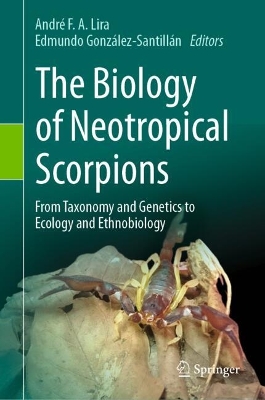
The Biology of Neotropical Scorpions focuses on comprehensive aspects of scorpions of the Neotropical region, such as public health to biogeographic history. This innovative book is devoted to tackling that lack of knowledge and bringing together a bundle of studies to offer students, researchers, and professionals a comprehensive background to start their research with scorpions as model organisms.
Since 1990 the study of scorpions thrived following the tradition focusing on the Palearctic and Neartic fauna, leaving behind ancient and important scorpion fauna localised in the Neotropics. The Neotropical region encompasses the tropical areas from South America to central Mexico, including the Antilles, comprising different biomes in their extension, such as deserts, dry forests, savannas, mountain ranges, and rainforests. These myriad environments influenced scorpions from their venom composition, morphology, and their human interactions.
Many researchers from different areas and countries have generated a growing piece of information about Neotropical scorpions, but this still is fragmentary. This book innovates in the biology of scorpion fluorescence, chromosomal and molecular genetics, conservation ecology, and ethnobiology of scorpions from the perspective of traditional medicine.
What are the Neotropical scorpions?.- Allometry and the evolution of
sexual size dimorphism in scorpions: insights from Neotropical species.-
Mating or not? Reproductive aspects of sexual reproduction and
parthenogenesis in Neotropical scorpions.- Luminescence and other optical
characteristics of scorpions exoskeleton.- Diversity, taxonomy, and
distribution of Neotropical scorpions.- Advances in the phylogenomic
relationships of Neotropical scorpions.- Fossil scorpions, with a focus on
the Neotropical species.- Biogeography of Neotropical scorpions: an
Overview.- Subterranean and troglomorphic scorpions from the Neotropics.-
Functional morphology and predatory and defensive behaviour in Neotropical
scorpions.- Sampling Techniques for Scorpions.- Cytogenetics of Neotropical
Scorpions.- Neotropical scorpions as useful models for ecological studies.-
Traditional treatment of scorpion stings in the Neotropics.- Neotropical
scorpion venom.- Scorpionism in Neotropics: public health issues and
prevention.- Managing scorpionism: envenomation, diagnostics, and therapeutic
approaches.- Perspectives on biology and interactions with humans of
Neotropical scorpions.
André Felipe de Araujo Lira is a biologist (Ph.D. in Animal Biology, 2018) who has been dedicated to the study of arachnids in the Neotropical region. His main interests are ecology and the behaviour of scorpions, pseudoscorpions, and harvestmen. He has conducted research focused on the conservation ecology, landscape ecology, macroecology, and defensive and reproductive behaviour of these arachnids for more than 10 years resulting in more than 100 published peer-reviewed articles and 1,000 citations.
Edmundo Gonzįlez-Santillįn is a Ph.D. in Ecology, Behavior, and Evolutionary Biology program at CUNY (2013) who focuses on the origin, evolution, and maintenance of arachnids. He published over 30 peer-reviewed contributions on the Order Scorpiones and other arachnids, focusing mainly on Mexican fauna. He has extensive experience in teaching, outreach, and speaking in local and international meetings and congresses. He is the curator of the National Collection of Arachnids in the Biology Institute, UNAM, a full-time researcher, and group leader of the research group. He devoted more than 20 years to scorpion systematics research, venoms, and other salient biological features of scorpions.