Muutke küpsiste eelistusi

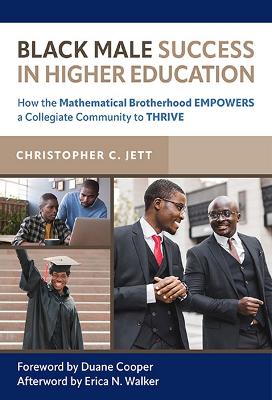
Black Male Success in Higher Education: How the Mathematical Brotherhood Empowers a Collegiate Community to Thrive [Kõva köide]

  • Formaat: Hardback, 208 pages, kõrgus x laius x paksus: 229x152x14 mm, kaal: 363 g
  • Ilmumisaeg: 26-Aug-2022
  • Kirjastus: Teachers' College Press
  • ISBN-10: 0807767417
  • ISBN-13: 9780807767412
  • Formaat: Hardback, 208 pages, kõrgus x laius x paksus: 229x152x14 mm, kaal: 363 g
  • Ilmumisaeg: 26-Aug-2022
  • Kirjastus: Teachers' College Press
  • ISBN-10: 0807767417
  • ISBN-13: 9780807767412
"This book examines the experiences of a cohort of 16 Black male math majors. It amplifies the participants' voices to chronicle their persistence in the major. Using Black masculinity and critical race theory, the author employs an asset-based approach to tell a captivating story about this cohort within a racially affirming learning community. This book showcases the nation's top producer of Black male math majors, extends the knowledge base regarding HBCUs' multigenerational legacy of success, and makes a significant contribution to the growing body of discipline-based education research. In so doing, the author provides recommendations for families, educators, policymakers, and researchers to improve Black boys' and men's mathematics achievement outcomes"--

For more than 175 years, historically Black colleges and universities (HBCUs) have played a significant role in educating Black students. This book examines the experiences of a cohort of 16 Black male math majors at Morehouse College referred to as “the mathematical brotherhood.” Through the lenses of Black masculinity and critical race theory, the author employs an asset-based approach to tell a captivating story about this cohort within a racially affirming learning community. Readers will hear how Morehouse empowers the students, as well as how they navigate and manage ongoing racial challenges, mathematical spaces, and society. Amplifying the voices of the participants, the study showcases the nation’s top producer of Black male math majors, extends the knowledge base regarding HBCUs’ multigenerational legacy of success, and makes a significant contribution to the growing body of discipline-based education research. The author provides recommendations for families, educators, policymakers, and researchers to improve Black boys’ and men’s mathematics achievement and academic outcomes.

Book Features:

  • Centers Black males’ cautionary tales about navigating school and society not only in their college years, but also in their formative years.
  • Provides insights regarding Black males’ persistence in mathematics.
  • Includes ethnographic data that brings a math learning community to life.
  • Draws upon race-related frameworks to document Black male success in college.

Arvustused

"This book pushes beyond the common stereotypes of Black exceptionalism that the school is commonly associated with, and anchors the study using Black masculinity and Critical Race Theory to unpack the complex nature of mathematics and the racial contexts of Black male students in higher education."Teachers College Record

Foreword xi
Duane Cooper
Prelude xiii
Acknowledgments xvii
Introduction 1(12)
Why Mathematics?
2(3)
Why Brothers?
5(3)
HBCUs
8(2)
Scholarship on Mathematics at HBCUs
10(1)
Overview of the Book
11(2)
1 Morehouse Mathematics
13(13)
Morehouse College: An Institutional Portrait
13(2)
Morehouse Mathematics: A Historical Portrait
15(4)
Morehouse Mathematics: A Contemporary Portrait
19(7)
2 The Brothers' Journey to Morehouse Mathematics
26(18)
Family Dynamics
26(1)
Journey to Mathematics
27(11)
Journey to Morehouse
38(4)
Conclusion
42(2)
3 The Mathematical Brotherhood
44(21)
Morehouse's Brotherhood
44(2)
Major Declaration
46(3)
The Mathematical Brotherhood
49(4)
Mathematical Persistence
53(3)
Mathematical Trials and Tribulations
56(5)
Division Among the Brothers
61(2)
Conclusion
63(2)
4 The Faculty
65(19)
The Mathematics Faculty
65(4)
Student-Generated Descriptions of the Mathematics Faculty
69(6)
Less Highly Regarded Mathematics Faculty
75(3)
Faculty Improvements
78(2)
Non-Mathematics Faculty
80(2)
Conclusion
82(2)
5 Morehouse's Mathematics Learning Community
84(21)
Math Lab
84(3)
Third Floor Respect
87(2)
Third Floor Disrespect
89(3)
Collegiate Activities and Events
92(7)
Alumni-Related Activities and Events
99(3)
Summary of Activities and Events to Promote Community
102(1)
Conclusion
103(2)
6 The Brothers' Racialized Experiences
105(16)
Racialized K-12 Experiences
105(4)
Racialized Experiences in Math-Related Contexts
109(4)
Racialized Experiences in Everyday Life
113(5)
Morehouse as a Racially Affirming Space
118(2)
Conclusion
120(1)
7 Moving Forward
121(18)
Future Goals and Aspirations
121(3)
Implications for Undergraduate Math Education
124(4)
Implications for Families
128(2)
Implications for K-12 Math Education
130(2)
Implications for Broadening the Participation of Black Men in the Mathematical Sciences
132(2)
Implications for Policy
134(1)
Implications for Future Research
135(2)
Coda
137(2)
Afterword 139(4)
Erica N. Walker
Appendix A Theoretical and Methodological Notes 143(4)
Appendix B Observational Data 147(4)
Appendix C Fraternal Vocabulary 151(2)
Appendix D Acronym Glossary 153(2)
Notes 155(2)
References 157(18)
Index 175(8)
About the Author 183
Christopher C. Jett is an associate professor of mathematics education in the College of Education & Human Development at Georgia State University. He received an NSF CAREER award, the 2019 Association of Mathematics Teacher Educators (AMTE) Early Career Award, and a 2019 Presidential Early Career Award for Scientists and Engineers (PECASE).