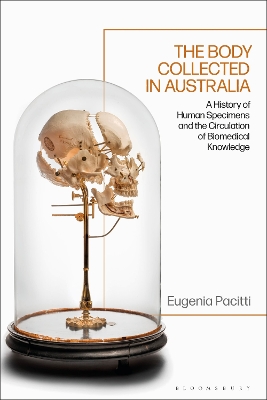
Offering insight into nineteenth- and early twentieth-century medical school dissecting rooms and anatomy museums, this book explores how collected human remains have shaped Western biomedical knowledge and attitudes towards the body.
To explore the role Australia played in the narrative of western medical development, Pacitti focuses on how and why Australian anatomists and medical students obtained human body parts. As medical knowledge circulated between Australia and Britain, the colony's physicians conformed to established specimen collecting practices and diverged from them to form a distinct medical identity. Interrogating how these literal and figurative bones of contention have left an indelible mark on the nation's medical profession, collecting institutions, and communities, Pacitti sheds new light on our understanding of western medical networks and reveals the opportunities and challenges historic specimen collections pose in the present day.
The Body Collected in Australia is a cultural history of collectors and collections that deepens our understanding of the ways the living have used the dead to comprehend the intricacies of the human body in illness and good health.
Arvustused
This is an impressive first book exploring the history of human specimens in Australian medical and cultural history. It presents extensive research in textual and material sources, such as the Melbourne Medical Museum, alongside the existing literature in this area. * Australian and New Zealand Society for the History of Medicine Book Prize *
Muu info
A study into how collected human remains in Australia have shaped global, Western biomedical knowledge and attitudes towards the body over the past 200 years.
Introduction: Bones of Contention
1. Dissecting the Culture of Anatomy
2. Collecting and Transforming Body Parts into Specimens
3. Anatomy of a Museum
4. Finding Unrealised Lives
5. War Pathology Specimens
6. Moving Parts
Conclusion: Afterlives
Dr Eugenia Pacitti is a historian of medicine based in Australia. She works in collection management, and her interests encompass specimen collection, medical education and professional networks in late nineteenth- and early twentieth-century Australia. She has a PhD in History from Monash University and her writing has appeared in Social History of Medicine and The Conversation.