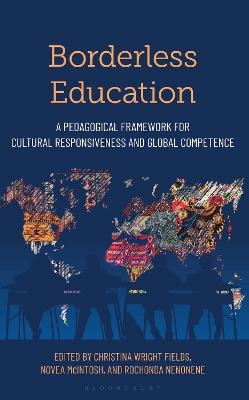
This text interweaves intersectional global and culturally responsive teaching frameworks to help pre-service teachers understand how to construct classrooms without borders.
Borderless Education serves as a conduit between global and domestic diversity by bridging the gap between global and cultural competence.
This book builds on the work of scholars who have called for culturally relevant, responsive, and sustaining teaching and pedagogies in education. The goal of this text is to provide an intersectional global and culturally responsive teaching approach that offers futuristic possibilities of reimagining learning without borders. Opening the conversation for readers to consider dialogue, collaboration, and research between two fundamentally important pedagogical frameworks, that each have a long-standing legacy and impact in teacher education. In light of our educational ecosystem, now is a time for the convergence of these frameworks to fully incorporate the principles and practices of culturally responsive and sustaining pedagogy (CRSP) with the multifaceted elements of global competencies. The authors share a new globalized pedagogical framework that bridges the gap between CRSP and international teacher education.
The internationalization of the American classroom is here; thus, it is crucial that this book be part of the foundation of teacher candidate preparation. America's pluralistic society already exists. We have diverse, diasporic cultural spaces in our local communities, recognizing that local global competency is distinctly different from domestic cultural competency. We offer the critique that America's EPP global education is limited because it generally prepares teacher candidates to be observers, “saviors,” and tourists, rather they should be compassionate and empathic allies that recognize and appreciate the necessity of a holistic global approach. There is a necessity for a comprehensive and integrative approach that includes global competencies which supports teachers candidates' development of an appreciation for diversity and sensitivity of all individuals within our local spaces as part of a larger cross-cultural environment.
Global awareness, social justice, diversity, and equitable practices are critical issues necessary for today's educators. This book encourages educators and practitioners to implement an intersectional globally and culturally responsive teaching approach that not only recognize but sustain students' cultural identities to enhance their academic achievement, increase their sense of belonging and inclusion in a pluralistic society, while raising their sociopolitical consciousness. This book is advantageous for readers searching for knowledge and strategies to support their application of a globalized pedagogy.
Arvustused
Through research and real-life examples, this work brings to life the concept of a globalized pedagogical framework while emphasizing the importance of culturally relevant and sustaining pedagogies (CRSP). From storytelling to borderless curriculum to peacebuilding, for example, various angles are provided to demonstrate how CRSP can work in teacher education internationally, with each chapter having its own unique flavor. The reflective questions posed in the introduction provide a solid purpose for reading. And, the recommendations and resources provided at the end set up educators for success with clear examples. -- Dr. Gilda Martinez-Alba * Professor, College of Education, Towson University *
Muu info
This book offers a new framework as the nexus between global competencies and culturally responsive/sustaining pedagogies as it pertains to educator preparation and responding to Americas increasingly global classrooms. Through the Integrative Global CRSP framework, unit plan, curriculum audit, and engaging chapters exemplifying active application of borderless practices, advocacy and activism.
Foreword
Preface
Acknowledgments
Introduction: The Case of a Globalized Pedagogical Framework in Teacher
Education
Part I Operationalizing the Global Pedagogical Framework in Curriculum and
Content
1 Storytelling for an Anti-conquest Curriculum: Nurturing Epistemological
Diversity in the Global Education Ecology
Kasun Gajasinghe, Alyssa Morley, and Yetunde Alabede
2 Borderless Curriculum: Shaping Instruction through Re-imagined Pedagogies
and Practices for a Global Community
Shabina Kavimandan, Amanda Lickteig, Éder Intriago-Palacios, and Mona Menking
3 Collaborative Mathematical Endeavors as Pillars of Global Education
Arthur Powell, Hanna Haydar, and Chadd McGlone
4 Conflict and Peacebuilding in Northern Ireland and the United States: A
Comparative Educational Study
Thomas M. Falk, Colleen Gallagher, and Lindsay A. Gold
Part II Blurring the Lines between Local and Global: Fostering
Borderlessness
5 Developing Empathy through Activist Art: Young Adult Texts with Culturally
Sustaining Practices
Elizabeth Wilkins
6 Religious Diversity and Culturally Responsive Sustaining Learning and
Teaching in a Global Context
Yooyeun Hwang
7 Critical Global Citizenship Education by South Korean Civic Organizations:
Implication for Multiculturalism in South Korea
Seeun Jeon
8 The Impact of School Organizational Structure: A Case Study of
Administration of Special Education to Young Children of Immigrants
Cady Landa
9 Exploring Experiential Learning: A Duoethnographic Study on US Pre-service
Teachers in Costa Rica
Ekaterina Koubek and Olman Vargas Rojas
Part III Conclusion, Recommendations, and Resources
10 Invitation to the Process: Applying an Integrative Global-CRSP Framework
Rochonda Nenonene, Novea McIntosh, and Christina Wright Fields
11 Committing to the Integrative Global CRSP Practices through Unit Plan
Development
Novea McIntosh,Christina Wright Fields, and Rochonda Nenonene
12 Designing a Unit Plan Utilizing the Integrative Global CRSP Framework
Christina Wright Fields, Rochonda Nenonene, Novea McIntosh, and Jennifer
Wu-Pope
13 The Quilted Classroom Poem: Harnessing Poetry to Cultivate Global and
Cultural Awareness
Novea McIntosh, Christina Wright Fields, Rochonda Nenonene, and Isabella
Lundgren
14 Examining Organizations Culturally Sustaining Global Education Strategies
through an Audit of Integrative Global CRSP Framework
Christina Wright Fields, Rochonda Nenonene, and Novea McIntosh
Resource Guide: Understanding the PossibilitiesUsing the Resource Guide for
the Integrative Global CRSP Framework
Bibliography
Index
About the Editors
About the Contributors
Christina Wright Fields, PhD (Poughkeepsie, New York) is an Associate Professor of Education at Marist University. Dr. Fields research focuses on culturally responsive pedagogy, urban education, equitable administrative practices, and global education. Prior to joining Marist College, Dr. Fields oversaw a pre-college global infusion project at Indiana University Bloomington with Dr. Amy Horowitz. Dr. Fields received the 2022 Longview Foundation Global Teacher Education Fellowship, 2019 Marist College Strategic Plan GrantThink Global, Act Local: Developing Social Justice Minded Youth, and 2017 NASPA Program Excellence Award in International, Multicultural, Cultural, Gender, LGBTQ, Spirituality and Disability. Dr. Fields served as 20222024 co-chair for American Association of Colleges of Teacher Educators (AACTE) Global Diversity Programmatic Advisory Committee and was a member of AACTEs Global Teacher Education Professional Learning Community. Currently, she serves as a Collaborative Online International Learning (COIL) coordinator at Marist University and the co-chair for the American College Personnel Association (ACPA) Commission for Academic Affairs. Dr. Fields has presented at American Education Research Association (AERA), International Conference on Urban Education (ICUE), International Visual Sociology Association (IVSA), Critical Race Studies in Education Association (CRSEA), and American Association of Colleges of Teacher Educators (AACTE). She has published in Administration Theory & Praxis, Black Educology, Public Integrity, Journal of African American Women and Girls in Education, and Journal of Education Human Resources.
Novea McIntosh, Ed.D. is an Associate Professor in the School of Education and Health Sciences at the University of Dayton. Dr. McIntosh coordinates the Adolescent to Young Adult program (Secondary education licensure) and co-directs the Urban Teacher Academy. Dr. McIntosh is an Afro Caribbean scholar practitioner whose research focuses on culturally responsive pedagogy, intercultural competence, decolonization and global education. As a global scholar, she collaborates with the University of Dayton Human Rights Center and NGOs such as Determined to Develop leading international interdisciplinary practicum to Malawi Africa, and study abroad in Florence Italy. Dr. McIntosh received the 2024 Longview Foundation Global Teacher Education Fellowship and 2025 Collaborative Online International Learning (COIL) University of Dayton fellowship. Dr. McIntosh served as 20242025 co-chair for American Association of Colleges of Teacher Educators (AACTE) Global Diversity committee and was a member of AACTEs Global Teacher Education Professional Learning Community. She currently serves as the President for the North American Community: Uniting for Equity (NAC:UE) and secretary for AACTE Internationalization of Teacher Education Topical Action Group (TAG). Dr. McIntosh coaches and provides professional development to in-service and pre-service teachers. She presented at American Association of Colleges of Teacher Educators (AACTE), American Educational Research Association (AERA), and the American Educational Studies Association (AESA). Dr. McIntoshs scholarly work has been published in national and international journals. Recent publications include: Teacher Preparation Partnerships to Foster Learning for All Students. Middle School Journal 55(1); Disrupting and transgressing the canon: Including BIPOC voices in BIPOC Alliances: Building Communities and Curricula for the Curriculum & Pedagogy; and Developing Culturally Responsive Antiracist Activists in Reconceptualizing Social Justice in Teacher Education: Moving to Anti-racist Pedagogy. Additionally, she has published in Michigan Journal of Community Service Learning, Understanding and Dismantling Privilege, Journal of Catholic Education, Journal of Interdisciplinary Education and International Journal of Educational Reform.
Rochonda Nenonene, Ph.D. is an associate professor in the department of teacher education at the University of Dayton. She serves as the First Year Experience Coordinator and the Founding Co-Program Director of the Urban Teacher Academy. Areas of research interests include: urban teacher preparation, culturally responsive/sustaining pedagogy, social-emotional learning and dispositions of teacher candidates. Dr. Nenonene conducts professional development for school districts on culturally responsive teaching, student engagement, classroom management, social-emotional learning and issues relevant to equity and social justice. Dr. Nenonene is a 2022-2023Institute for Teachers of Color Fellow (ITOC) and 2019 University of Dayton Global Education Fellow. She currently serves as the President for theGlobal Community: Uniting for Equity (GCUE) and Co-chairs the membership committee for American Association of Colleges of Teacher Educators (AACTE). Dr. Nenonene has presented at American Association of Colleges of Teacher Educators (AACTE), American Educational Research Association (AERA) and the American Educational Studies Association (AESA). Recent publications include: Social Emotional Learning. In Reiser, R., Carr-Chellman, A., Dempsey, J. (Eds.), Trends and Issues in Instructional Design and Technology, 5th Edition (Chapter 12), Routledge; Disrupting and transgressing the canon: Including BIPOC voices in BIPOC Alliances: Building Communities and Curricula for the Curriculum & Pedagogy; and Developing Culturally Responsive Antiracist Activists in Reconceptualizing Social Justice in Teacher Education: Moving to Anti-racist Pedagogy. Additionally, she has published in Teacher Education Quarterly, Understanding and Dismantling Privilege, Journal of Catholic Education, and Multicultural Learning and Teaching.