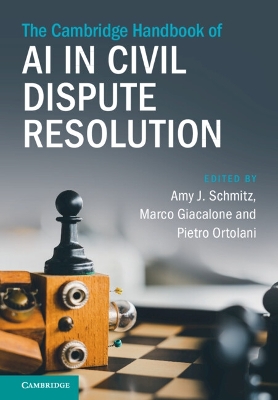
The Cambridge Handbook of AI in Civil Dispute Resolution is the first global, in-depth exploration of how artificial intelligence is transforming civil justice. Moving past speculation, it showcases real-world applications-from predictive analytics in Brazil's courts to generative AI in the Dutch legal system and China's AI-driven Internet Courts. Leading scholars and practitioners examine the legal, ethical, and regulatory challenges, including the EU AI Act and emerging governance frameworks. With rich case studies and comparative insights, the book explores AI's impact on access to justice, procedural fairness, and the evolving publicprivate balance. Essential reading for legal academics, policymakers, technologists, and dispute resolution professionals, it offers a critical lens on AI's promise-and its limits-in reshaping civil dispute resolution worldwide.
Arvustused
'Artificial intelligence is permeating all sectors of activity, and conflict resolution is no exception. This collaborative work provides a comprehensive overview of the uses and practices of AI in conflict resolution that are beginning to develop, and also offers an interesting perspective on future trends. An essential book for anyone interested in the use of technology in civil justice.' Karim Benyekhlef, Cyberjustice Lab, Université de Montréal 'This volume convenes many of the top minds applying artificial intelligence to civil dispute resolution processes, creating a guidebook for where the ADR field is headed. The authors distill both what we know and what we need to know, enabling dispute systems designers to minimise the harms and maximise the benefit from AI's inevitable expansion. I believe the dispute resolvers of tomorrow will come to regard this book as an important milestone in envisioning the future of global dispute resolution.' Colin Rule, President and CEO, ODR
Muu info
Globe-spanning analysis of AI in civil dispute resolution, with legal, ethical and policy insights across public and private justice systems.
Part I. The State of Play:
1. Responsible use of AI in civil dispute
resolution Amy J. Schmitz;
2. Fitting AI within the dispute system design
framework Janet K. Martinez and Grande Lum;
3. From AI ethics to AI
regulation: emerging regulatory frameworks for AI-enhanced justice Natali
Helberger and Isabella Banks;
4. The roles AI is (and should be) playing in
dispute resolution: on the legitimacy of AI legal applications Orna
Rabinovich and Talia Schwartz;
5. Balancing innovation and ethics: a content
analysis of framework documents regulating generative AI in legal practice
Giampiero Lupo; Part II. AI and Public Sector Dispute Resolution:
6. AI
governance beyond EO 14110: federal efforts, state regulations, and civil
litigation Iria Giuffrida and Daniel Shin;
7. The EU AI act and its effects
on AI-enhanced civil justice in Europe Martin Ebers, Benedikt Quarch and
Patrik Rode;
8. Artificial Intelligence and international commercial courts
Georgios Dimitropoulos and Umar Azmeh;
9. Generative AI and civil justice:
towards responsible use in judicial workflows Anna van Duin and Rachel
Rietveld;
10. The use of AI in China's internet courts Chen Lei and Jia Wang;
11. Integrating AI in the Brazilian justice system Roberto Baumgarten Kuster
and Elisa Lucena;
12. VoorRecht-rechtspraak: enhancing access to justice in
the Netherlands with online (supported) dispute resolution Pieter van
Riemsdijk and T. J. Helling;
13. The Terminator Judge III: the rise of the
machines Nicolįs Lozada, Federico Olsen and Jacobo Gómez; Part. III. AI and
Private Sector Dispute Resolution:
14. Integrating AI in mediation Hannes
Westermann;
15. The legal validity of the adoption of AI in decision-making
in international commercial arbitration Sarah Hourani;
16. AI and arbitration
in sub-sahara African countries Emilia Onyema;
17. AI and tools for expanding
access to justice Quinten Steenhuis;
18. Contract performance management
tools: the monitoring of contracts execution Silvia Martinelli; Part IV.
Lessons for the Future:
19. AI and the public/private divide in civil dispute
resolution Pietro Ortolani;
20. AI's role and challenges in shaping the
future of arbitration Maud Piers and Hannah-Carlota Osaer;
21. AI and the
future of public courts Nicolas Vermeys and Jinzhe Tan;
22. AI and the future
of private dispute resolution settlements Marco Giacalone.
Amy J. Schmitz is Professor & John Deaver Drink-Baker & Hostetler Chair in Law at The Ohio State Moritz College of Law. She is also a Co-Director of the Translational Data Analytics Institute (TDAI) CoP for Responsible Data Science as well as the Founder and Director of the JusticeTech Program at The Ohio State University. She is elected into the American Law Institute and has published extensively throughout the world, twice winning the CPR international book award and recently the ABA Award for Scholarly Achievement in Dispute Resolution. Marco Giacalone is a Research Professor in the Department of Private and Economic Law (PREC) at the Vrije Universiteit Brussel (VUB), where he is also a Co-Director of the Research Group on Digitalisation and Access to Justice (DIKE). His research examines the intersection of law, digitalisation, and access to justice, with particular focus on online dispute resolution (ODR), the use of AI in civil procedure, and comparative international perspectives. Pietro Ortolani is a Full Professor of Digital Conflict Resolution at Radboud University in Nijmegen, the Netherlands. Professor Ortolani has published in many peer-reviewed international journals, including the European Journal of International Law, the Oxford Journal of Legal Studies, the Journal of International Dispute Settlement and the Leiden Journal of International Law.