Muutke küpsiste eelistusi

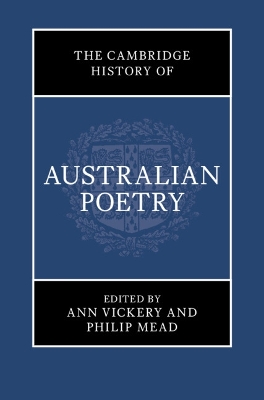
Cambridge History of Australian Poetry [Kõva köide]

Edited by (Deakin University), Edited by (University of Western Australia)
  • Formaat: Hardback, 942 pages, kõrgus x laius x paksus: 235x159x57 mm, kaal: 1420 g, Worked examples or Exercises
  • Ilmumisaeg: 11-Dec-2025
  • Kirjastus: Cambridge University Press
  • ISBN-10: 1009237195
  • ISBN-13: 9781009237192
Teised raamatud teemal:
  • Kõva köide
  • Hind: 123,75 €*
  • * hind on lõplik, st. muud allahindlused enam ei rakendu
  • Tavahind: 165,00 €
  • Säästad 25%
  • Raamatu kohalejõudmiseks kirjastusest kulub orienteeruvalt 3-4 nädalat
  • Kogus:
  • Lisa ostukorvi
  • Tasuta tarne
  • Tellimisaeg 2-4 nädalat
  • Lisa soovinimekirja
  • Formaat: Hardback, 942 pages, kõrgus x laius x paksus: 235x159x57 mm, kaal: 1420 g, Worked examples or Exercises
  • Ilmumisaeg: 11-Dec-2025
  • Kirjastus: Cambridge University Press
  • ISBN-10: 1009237195
  • ISBN-13: 9781009237192
Teised raamatud teemal:
The Cambridge History of Australian Poetry offers an authoritative and comprehensive engagement with poetries that range from some of the world's oldest to significant innovations of the twenty-first century. Bringing together insights from First Nations experts, internationally renowned scholars, distinguished practitioners, and future critical leaders, this volume analyses the role of poetry in the multiple cultural imaginaries of Australia within local, regional, and global contexts. Chapters consider the role of poetry as both shaping and critiquing settler-colonial, national, and identity formations; Aboriginal writing, song, and cultural leadership; children's poetry; the poetry of war and conflict; engagement with print, film, and the digital; major aesthetic movements; geographies of the city, region, Asia, the South, and Antarctica; diasporic movements; and environmentalism. The volume includes analyses of the archive, ballads and folk poetry, performance poetries, conceptual and concrete poetries, canon formation and diversification, and current perspectives on major authors.

Muu info

Provides comprehensive analyses of poetic engagements with multiple histories, forms, and contexts of Australian poetry.
Introduction Ann Vickery and Philip Mead;
1. Language, text and colony:
rethinking aboriginal poetry of the eighteenth and nineteenth centuries
Eugenia Flynn;
2. British speculations of Terra Australis and romantic-period
poetry Robert W. Rix;
3. Poetry in the penal colony Thomas H. Ford and Kyle
Kohinga;
4. Becoming distinct: nineteenth-century Australian poetry Paul
Giles;
5. The many-voiced Charles Harpur Paul Eggert;
6. Anonymity and the
popular: the Colonial ballad and other folk forms Michael Farrell;
7. Settler
labour poetics and the national imaginary at the turn of the twentieth
century Jonathan Dunk;
8. Children's poetry from 1840 to 1950 Kristine Moruzi
and Beth Rodgers;
9. Australian poetries of war and conflict Ann Vickery;
10.
'Poetry is its own advertisement': little magazines, clubs, and coteries
(18901945) Peter Kirkpatrick;
11. The new woman and poetry (18851935) Jess
Cotton;
12. Women poets, mobility, and being 'in-between' Nancy Berke;
13.
Fin de Siècle symbolism and after Toby Fitch;
14. Kenneth Slessor's visualism
Philip Mead;
15. Surrealism and Australian poetry Gavin Yates;
16. Gum tears
which are also real: manifesto and hoax in the Jindyworobak and Ern Malley
Nicholas Birns;
17. The mid-century canon: post-sham Australia Georgina
Arnott;
18. Judith wright Sarah Kennedy;
19. Oodgeroo Noonuccal Peter Minter;
20. Aboriginal song as Australian poetry: the unimaginable archive Nicholas
Jose;
21. Re-imagining place (19401990) Bonny Cassidy;
22. Australian poetry
and the rise of a Suburban Quotidian, 19502000 Paul Hetherington and
Cassandra Atherton;
23. The three ontologies of regional poetry Tony
Hughes-D'aeth;
24. The poetry of Antarctica Elizabeth Leane;
25. Poetry and
the State (1945 to the Present) Ali Alizadeh;
26. Australian expatriate poets
Andrew Taylor;
27. Les Murray Michael Hofmann;
28. Religion and poetry in
Australia Lyn Mccredden;
29. Francis Webb Bill Ashcroft;
30. Australian
poetry and post-war immigration from Europe Konstandina Dounis;
31. The long
1970s and print culture Fiona Scotney;
32. Australian poets of the 1980s John
Hawke;
33. Activism and the Eruption of aboriginal writing Philip Morrissey;
34. Reading the archive of Australian feminist poetry since 1970 Kate Lilley;
35. Queer poetry in Australia: 1970s to today Jill Jones and Bonnie Reid;
36.
Between identity and form: Asian Australian poetry Prithvi Varatharajan and
Lucy Van;
37. Poetry of the South West Asian and North African diasporas
Paula Abood;
38. Trancultural relations with Latin America Stuart Cooke;
39.
Performance poetries Andy Jackson;
40. Long form poetry from the 1980s to the
present Simon Eales;
41. From conceptual to concrete (19602020):
parahistoriographies A.J. Carruthers;
42. The digital era Hazel Smith;
43.
The Earth has been done: recent environmental poetry Tom Bristow;
44.
Contemporary anthologies and the question of canonicity Jaya Savige;
45. New
dynamics in twenty-first century anthologies Jaya Savige.
Ann Vickery is the author of Leaving Lines of Gender: A Feminist Genealogy of Language Writing (2000), Stressing the Modern: Cultural Politics of Australian Women's Poetry (2007) and three poetry collections. She is co-author of The Intimate Archive: Journeys into Private Papers (2009), editor of The Cambridge Companion to Australian Poetry (2024), and co-editor of Poetry and the Trace (2013). Philip Mead is the author of Network Language: Culture and History in Australian Poetry (2009; repr. 2010, 2011, 2018) and winner of the 2010 New South Wales Premier's Literary Award for Literary Scholarship. He is co-author of Antipodal Shakespeare: Remembering and Forgetting in Britain, Australia and New Zealand, 19162016 (2018) and a fellow of the Australian Academy of Humanities.