Muutke küpsiste eelistusi

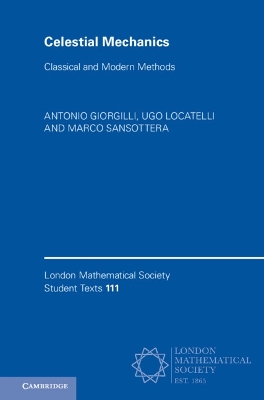
Celestial Mechanics: Classical and Modern Methods [Pehme köide]

(Rocketloop Labs, Germany), (Università degli Studi di Roma 'Tor Vergata'), (Istituto Lombardo Accademia di Scienze e Lettere, Milan)
  • Formaat: Paperback / softback, 451 pages, Worked examples or Exercises
  • Sari: London Mathematical Society Student Texts
  • Ilmumisaeg: 31-May-2026
  • Kirjastus: Cambridge University Press
  • ISBN-10: 1009595326
  • ISBN-13: 9781009595322
  • Pehme köide
  • Hind: 77,25 €
  • See raamat ei ole veel ilmunud. Raamatu kohalejõudmiseks kulub orienteeruvalt 3-4 nädalat peale raamatu väljaandmist.
  • Kogus:
  • Lisa ostukorvi
  • Tasuta tarne
  • Tellimisaeg 2-4 nädalat
  • Lisa soovinimekirja
  • Formaat: Paperback / softback, 451 pages, Worked examples or Exercises
  • Sari: London Mathematical Society Student Texts
  • Ilmumisaeg: 31-May-2026
  • Kirjastus: Cambridge University Press
  • ISBN-10: 1009595326
  • ISBN-13: 9781009595322
Starting from ancient astronomy, this text follows the development of celestial mechanics culminating in applications of the most recent results concerning stability of planetary orbits: Kolmogorov's and Nekhoroshev's theorems. Key topics covered include: a historical introduction from ancient astronomy to Kepler and Newton; Lagrange's perturbation theory; the problem of three bodies, with a discussion of Levi-Civita regularization and of Sundman's theorem; methods of algebraic calculation of perturbation series, including a discussion of non-convergence due to the accumulation of small divisors; and a complete application of Kolmogorov's and Nekhoroshev's theorems. Written in an accessible, self-contained way with few prerequisites, this book can serve as an introductory text for senior undergraduate and graduate students, and for young researchers. Its approach allows students to learn about perturbation methods leading to advanced results.

Arvustused

'This book on Celestial Mechanics remarkably integrates theoretical analysis, historical context, and modern computational methods. The subjects addressed span from Kepler's laws to the stability of planetary systems. It constitutes an indispensable resource for students and researchers involved in the fields of Celestial Mechanics and Dynamical Systems.' Alessandra Celletti, Department of Mathematics, University of Rome Tor Vergata 'Reflecting the school of thought sculpted over the years by the senior author and two of his beloved scientific children, this book offers a step-by-step historical approach to the development of virtually all central concepts of utility in modern celestial mechanics and canonical perturbation theory, accompanied by some of the authors' well-known contributions. The text balances rightly between mathematical rigor and conceptual clarity, and it is highly recommended both as textbook or reference for advanced researchers in the field.' Christos Efthymiopoulos, University of Padua, Italy 'Celestial Mechanics: Classical and Modern Methods is written by world leaders in celestial mechanics and is a joy to read. It combines state of the art mathematical methods in their application to some of the most famous problems in celestial mechanics such as the Three-Body Problem or the stability of the solar system. This book is very special in linking the modern view of celestial mechanics into a historical perspective that is developed much beyond what is usually seen.' Jacques Laskar, Paris Observatory 'This is a true space opera of celestial mechanics - from the ancients to the present day. The vivid narrative moves seamlessly from classical to contemporary methods, complementing the mathematical developments with a rich historical perspective. Its central theme is the timeless problem of the stability of planetary motion - a challenge to which the greatest minds - Newton, Poincaré, Kolmogorov, Arnold, among others - have made brilliant contributions. The authors themselves continue this lineage, presenting some of the most recent and significant advances in the field, culminating in a synthesis of classical perturbation theory with modern analytical and computer-assisted techniques. Yet the play is not over - the question of stability remains open, continuing to inspire and motivate present and future researchers. As a sequel to Notes on Hamiltonian Dynamical Systems, this volume brilliantly disproves the old saying that 'sequels are never any good.' In short, it is a compelling, inspiring, and truly rewarding work.' Àlex Haro, University of Barcelona

Muu info

Introduces celestial mechanics starting from ancient astronomy and culminating in applications of modern results.
Apology; Plan of the book; Part I. From Ancient Astronomy to Newton:
1.
Ouverture;
2. Kinematics of the Keplerian model;
3. The gravitation of
Newton; Part II. From Newton to Poincaré:4. Integrability and action-angle
variables;
5. The perturbing function;
6. Classical perturbation methods;
7.
The problem of three bodies;
8. Regularization of collisions; Part III.
Modern Celestial Mechanics:
9. A toolbox of perturbation methods;
10.
Computer-assisted methods for KAM theory;
11. Rotational dynamics of
celestial bodies;
12. Stability of planetary systems; A. Analytical tools; B.
Indexing functions; C. Validated numerics in CAP; D. Benchmarking CAP with a
simple model; References; Index.
Antonio Giorgilli is a Member of the Istituto Lombardo Accademia di Scienze e Lettere and a former Professor of Mathematics at the Università degli Studi di Milano, now retired. His research in dynamical systems focuses on the characterization of chaos, KAM theory and Nekhoroshev's theory on exponential stability. In addition to being an Invited Speaker of the 1998 International Congress of Mathematicians, Giorgilli's other notable honours include the international Gili Agostinelli Prize for Pure or Applied Mechanics or Classical Mathematical Physics by the Accademia delle Scienze di Torino in 2007. The minor planet 27855 Giorgilli is named in his honour. Ugo Locatelli is Full Professor of Mathematical Physics at the Università degli Studi di Roma 'Tor Vergata'. Since 2023, he has been President of SIMCA (Italian Society of Celestial Mechanics and Astrodynamics). From 1996 to 1999 he was supported by a Marie Curie Fellowship awarding his research project 'Stability in Celestial Mechanics problems into the light of KAM and Nekhoroshev's theory'. He is author of more than forty articles appearing in scientific journals, most in the field of dynamical systems. Marco Sansottera is a mathematician with a Ph.D. in Mathematics from the Università degli Studi di Milano. He held postdoctoral and research positions at the Università degli Studi di Roma 'Tor Vergata', the Université de Namur, and the Università degli Studi di Milano, where he has also taught courses in celestial mechanics, Hamiltonian systems and mathematical physics. His research interests lie in the long-term stability of dynamical systems, with particular emphasis on perturbation theory, KAM theory and Nekhoroshev estimates. He is author of more than twenty-five scientific publications.