Muutke küpsiste eelistusi

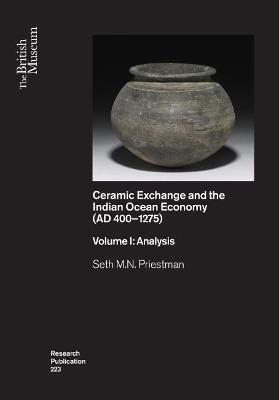
Ceramic Exchange and the Indian Ocean Economy (AD 400-1275). Volume I: Analysis [Pehme köide]

  • Formaat: Paperback / softback, 200 pages, kõrgus x laius: 297x210 mm, 100
  • Sari: British Museum Research Publications 223
  • Ilmumisaeg: 28-Aug-2021
  • Kirjastus: British Museum Press
  • ISBN-10: 0861592239
  • ISBN-13: 9780861592234
  • Pehme köide
  • Hind: 45,60 €*
  • * hind on lõplik, st. muud allahindlused enam ei rakendu
  • Tavahind: 57,00 €
  • Säästad 20%
  • Raamatu kohalejõudmiseks kirjastusest kulub orienteeruvalt 3-4 nädalat
  • Kogus:
  • Lisa ostukorvi
  • Tasuta tarne
  • Tellimisaeg 2-4 nädalat
  • Lisa soovinimekirja
  • Formaat: Paperback / softback, 200 pages, kõrgus x laius: 297x210 mm, 100
  • Sari: British Museum Research Publications 223
  • Ilmumisaeg: 28-Aug-2021
  • Kirjastus: British Museum Press
  • ISBN-10: 0861592239
  • ISBN-13: 9780861592234
In this groundbreaking book, Seth Priestman proposes a very rigorous methodology together with a strong critical sense and meets the readers expectations. The book fills a gap in the archaeology of the Indian Ocean that is severely lacking quantitative analysis of the available data. - _International Journal of Nautical Archaeology_

From AD 5001000, the Indian Ocean emerged as a global commercial centre, and by around 750800 a sophisticated trade network had been established involving the movement of goods from Japan and China in the east, to southern Africa and Spain in the west. However, the Indian Oceans commercial system has been relatively understudied, with many of the key assumptions regarding its development based on narrative textual sources and selective archaeological evidence. This study sets out the case for the unique significance of quantified ceramic finds as an indicator of long-term changes in the scale and volume of maritime exchange in a period for which few other sources of systematic economic history survive. The publication presents archaeological data from thirteen sites distributed across the western Indian Ocean, including Siraf (Iran), Anuradhapura (Sri Lanka) and Manda (Kenya). The ceramic assemblages are considered in terms of their general compositional characteristics and the distinctions between local, regional and long-distance exchange. The volume concludes with a discussion of how this data can be used to address the broader issues of long-term economic change and the relationship between state power in the Middle East and the commercial networks of the Indian Ocean operating via the Persian Gulf.
Acknowledgements iv
1 Quantifying Indian Ocean Ceramic Exchange
1(16)
2 An Integrated Ceramic Classification and Chronology
17(38)
3 Ceramic Quantification
55(8)
4 The Sites and Finds
63(105)
5 Quantitative Analysis of Ceramic Exchange
168(10)
6 Composition of Ceramic Exchange
178(31)
7 Ceramics and the Long-Term Economic History of the Western Indian Ocean
209(16)
Appendix: Ceramic Classes 225(31)
Notes 256(3)
Bibliography 259(13)
Index 272
Seth M.N. Priestman's research focuses on the Late Antique and Medieval archaeology of the Middle East, Transcaucasia and the Indian Ocean world. He has recently held post-doctoral research positions with the Department of Asia at the British Museum and the School of History Classics and Archaeology at the University of Edinburgh. A study he undertook of the finds from the major Early Islamic port of Siraf in southern Iran held by the British Museum laid the foundation for his PhD. Seth has worked on fieldwork, projects and has published widely in the field of Middle Eastern archaeology and ceramics research.