Muutke küpsiste eelistusi

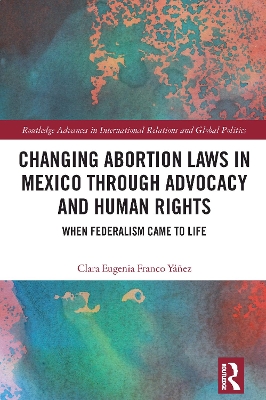
Changing Abortion Laws in Mexico Through Advocacy and Human Rights: When Federalism Came to Life [Pehme köide]

(University of Hamburg, Germany)
  • Formaat: Paperback / softback, 218 pages, kõrgus x laius: 234x156 mm, 18 Tables, black and white; 3 Line drawings, black and white; 13 Halftones, black and white; 16 Illustrations, black and white
  • Sari: Routledge Advances in International Relations and Global Politics
  • Ilmumisaeg: 22-Jun-2026
  • Kirjastus: Routledge
  • ISBN-10: 1032642378
  • ISBN-13: 9781032642376
  • Pehme köide
  • Hind: 48,81 €*
  • * hind on lõplik, st. muud allahindlused enam ei rakendu
  • Tavahind: 65,09 €
  • Säästad 25%
  • See raamat ei ole veel ilmunud. Raamatu kohalejõudmiseks kulub orienteeruvalt 3-4 nädalat peale raamatu väljaandmist.
  • Kogus:
  • Lisa ostukorvi
  • Tasuta tarne
  • Tellimisaeg 2-4 nädalat
  • Lisa soovinimekirja
  • Formaat: Paperback / softback, 218 pages, kõrgus x laius: 234x156 mm, 18 Tables, black and white; 3 Line drawings, black and white; 13 Halftones, black and white; 16 Illustrations, black and white
  • Sari: Routledge Advances in International Relations and Global Politics
  • Ilmumisaeg: 22-Jun-2026
  • Kirjastus: Routledge
  • ISBN-10: 1032642378
  • ISBN-13: 9781032642376
Changing Abortion Laws in Mexico Through Advocacy and Human Rights presents the recent evolution of abortion laws in Mexico (20072021) and how advocates have shaped them through human rights discourses, challenging social norms.

Utilizing extended expert interviews, it offers a uniquely deep dive into the mapping of Mexicos recent legal landscape concerning abortion, addressing an issue of concern for contemporary feminist movements. By thoroughly analyzing this debate as it happened on the ground in Mexico, the author examines how activists (for and against legal abortion) have shaped norms and laws, analyzing their proposals for legal and public policy reforms. The book maps out this sociopolitical and legal landscape throughout the past decade, beginning with abortion legalization in Mexico City in 2007, throughout the political backlash that ensued in other subnational states, and culminating with the Supreme Courts decision in 2021 to decriminalize abortion. The Mexican case is explored through a dual lens: firstly by zooming in to Mexico as a country case where federalism makes for a complex and fascinating legal landscape, and secondly by zooming out to networks of transnational advocates and their linkages to global norms and institutions. The concluding considerations provide closing reflections on the abortion in Mexico story and the ways in which advocates on this and other issue areas might find ways to advance ideas, normative concepts, find common ground with ideological opponents, and implement successful policy change.

This book will be of great interest to students and scholars of Politics and International Relations, International Law, Feminist Studies, and Latin American Studies.
1. Introduction: Abortion, Advocacy in Latin America and the Mexican
Case
2. The Mexican Case: An Abortion Storyline
3. Norm Contestation,
Advocacy, and Abortion as the Odd Human Rights Case
4. The Mexican Case: A
Tale of Two Discourses
5. Advocates in Times of Lawfare
6. Abortion in
International Laws, Institutions, and Global Debates
7. Concluding
Considerations: What Possible Pathways to Dialogue? Epilogue: A Research
Journey and the Way Full Circle
Clara Eugenia Franco Yáñez is a Mexican national and holds a PhD in Political Science from the University of Hamburg (UHH), Germany, and the German Institute of Global and Area Studies (GIGA) and an MA in International Affairs from the Geneva Graduate Institute of International and Development Studies (IHEID), Switzerland.