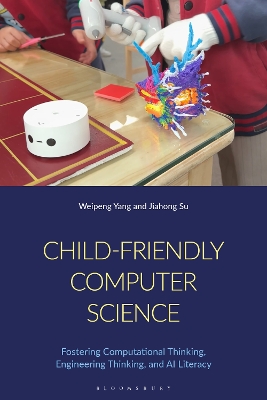
This book offers new insights and critical perspectives on the integration of computational thinking, engineering design process, and AI literacy into early childhood education.
This book offers new insights and critical perspectives on the integration of computational thinking, engineering design process, and AI literacy into early childhood education.
The authors draw on research from around the world in early childhood education and computer science education (CSE) to explore the possibilities, benefits and challenges of incorporating emerging technologies into the formal and informal learning settings for young children aged 3-8 years. They offer strategies and research insights for designing and implementing curricula, selecting appropriate tools, and engaging families, drawing upon a wide range of research and pedagogical approaches. With a strong emphasis on equity and inclusion the authors suggest developmentally appropriate CSE activities to develop skills like literacy, maths and problem-solving, while adhering to appropriate screen time guidelines. It is written for researchers, policy-makers and educators interested in advancing the field of early childhood education and empowering young children in the rapidly evolving digital society.
Muu info
This book offers new insights and critical perspectives on the integration of computational thinking, engineering design process, and AI literacy into early childhood education.
Introduction
1. What is Computer Science Education in Early Childhood
2. Computational Thinking in Early Childhood
3. Early Engineering, Making and Tinkering
4. Introducing Artificial Intelligence to Young Learners
5. Integrating Computer Science in Early Childhood Curricula
6. Technologies and Resources for Early Childhood Computer Science Education
7. Assessing Habits of Mind Among Young Children Participating in Computer
Science Education
8. Inclusive and Equitable Computer Science Education
9. The Role of Adult Educators
10. Policy Considerations and Future Directions for Computer Science
Education for Young Children
Conclusion
References
Index
Weipeng Yang is Assistant Professor of Early Childhood Education at The Education University of Hong Kong, Hong Kong. Jiahong Su is a PhD Candidate in the Faculty of Education at The University of Hong Kong, Hong Kong.