Muutke küpsiste eelistusi

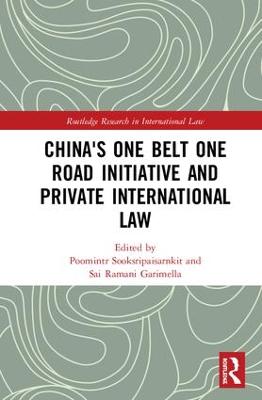
China's One Belt One Road Initiative and Private International Law [Kõva köide]

Edited by , Edited by (University of Tasmania, Australia)
  • Formaat: Hardback, 264 pages, kõrgus x laius: 229x152 mm, kaal: 453 g
  • Sari: Routledge Research in International Law
  • Ilmumisaeg: 16-May-2018
  • Kirjastus: Routledge
  • ISBN-10: 113856382X
  • ISBN-13: 9781138563827
  • Kõva köide
  • Hind: 159,19 €*
  • * hind on lõplik, st. muud allahindlused enam ei rakendu
  • Tavahind: 212,25 €
  • Säästad 25%
  • Raamatu kohalejõudmiseks kirjastusest kulub orienteeruvalt 3-4 nädalat
  • Kogus:
  • Lisa ostukorvi
  • Tasuta tarne
  • Tellimisaeg 2-4 nädalat
  • Lisa soovinimekirja
  • Formaat: Hardback, 264 pages, kõrgus x laius: 229x152 mm, kaal: 453 g
  • Sari: Routledge Research in International Law
  • Ilmumisaeg: 16-May-2018
  • Kirjastus: Routledge
  • ISBN-10: 113856382X
  • ISBN-13: 9781138563827
The concept of the One Belt One Road initiative (OBOR) was raised by the President of the People’s Republic of China in October 2013. The OBOR comprises the ‘Silk Road Economic Belt’ and the ‘21st Century Maritime Silk Road’, encompassing over 60 countries from Asia to Europe via Southeast Asia, South Asia, Central Asia, West Asia, and the Middle East. The overall objective of the OBOR is to encourage the economic prosperity of the countries along the Belt and Road and regional economic cooperation, encourage mutual learning between different civilizations, and promoting peace and development. However, countries along the Belt and Road routes of the OBOR project have diverse laws and legal systems. It is not difficult to envisage problems relating to harmonisation of laws and rules in trade between countries along the OBOR routes or otherwise. These problems can potentially cut through the core of the very objective of the OBOR itself. Integration in China’s One Belt One Road Initiative explores possible challenges to the success of the OBOR arising from the situational interface of diversity of laws, with the focus primarily on issues associated with private international law. It shows the latest state of knowledge on the topic and will be of interest to researchers, academics, policymakers, and students interested in private international law issues pertaining to the OBOR routes as well as private international law in general, Asian studies, and the politics of international trade.
List of editors and contributors
viii
Foreword xvi
Preface xviii
Acknowledgements xx
1 The role of private international law in the context of the One Belt One Road initiative
1(16)
Poomintr Sooksripaisarnkit
Sai Ramani Garimella
PART I Party autonomy
17(20)
2 Harmonisation of choice of law rules in commercial contracts in the One Belt One Road countries: will the Hague principles on choice of law in international commercial contracts serve as a good model?
19(18)
Poomintr Sooksripaisarnkit
PART II Service of process
37(16)
3 On the construction of electronic service abroad system under the `Belt and Road' Initiative
39(14)
Yujun Guo
Pengyuan Fu
PART III Jurisdiction
53(18)
4 Navigating Singapore's private international rules in the age of innovative cross-border commercial litigation framework
55(16)
Man Yip
PART IV Conflict of laws
71(52)
5 OBOR and the syncretic private international law rules in India: time for accession to harmonised legal regimes
73(21)
Sai Ramani Garimella
6 European Union legislation: how far does it reach beyond the EU border?
94(29)
Ivana Kunda
PART V Interpretation of foreign law and substantive harmonisation efforts
123(74)
7 Proof of foreign law under the background of the Belt and Road Initiative
125(19)
Zhengxin Huo
8 One Belt One Road - One law?
144(20)
Bruno Zeller
9 Thai conflict of law rules, China's One Belt One Road initiative and ASEAN trade facilitation: one common path with many exit routes
164(18)
Kittiwat Chunchaemsai
10 The "One Belt One Road" strategy - the role of private international law in combatting and strengthening anti-corruption standards transnationally
182(15)
Thomas John
Rishi Gulati
PART VI Judgments and arbitral awards recognition
197(56)
11 The role of Hong Kong in the dispute resolutions of One Belt One Road
199(19)
King Fung Tsang
12 The recognition of foreign judgments as a tool of economic integration: views from Middle Eastern and Arab Gulf countries
218(17)
Beligh Elbalti
13 Recognition and enforcement of foreign arbitration awards, foreign court judgments and contracts of international carriage
235(18)
Banu Bozkurt
Conclusion: tackling private international law issues for the success of the OBOR 253(3)
Poomintr Sooksripaisarnkit
Sai Ramani Garimella
Index 256
Poomintr Sooksripaisarnkit is a Lecturer in Maritime Law with the Australian Maritime College, University of Tasmania, Australia.


Sai Ramani Garimella is a Senior Assistant Professor at the Faculty of Legal Studies, South Asian University, New Delhi, India.