Muutke küpsiste eelistusi

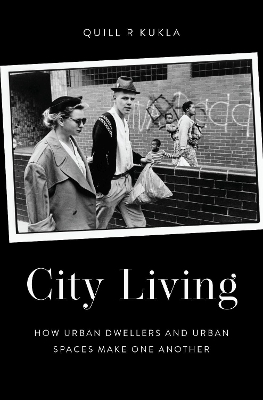
City Living: How Urban Spaces and Urban Dwellers Make One Another [Kõva köide]

(Professor of Philosophy and Senior Research Scholar, Kennedy Institute of Ethics at Georgetown University)
  • Formaat: Hardback, 344 pages, kõrgus x laius x paksus: 237x163x29 mm, kaal: 612 g, 12 color images; 56 b&w images
  • Ilmumisaeg: 02-Feb-2022
  • Kirjastus: Oxford University Press Inc
  • ISBN-10: 0190855363
  • ISBN-13: 9780190855369
Teised raamatud teemal:
  • Kõva köide
  • Hind: 37,49 €*
  • * hind on lõplik, st. muud allahindlused enam ei rakendu
  • Tavahind: 46,86 €
  • Säästad 20%
  • Raamatu kohalejõudmiseks kirjastusest kulub orienteeruvalt 3-4 nädalat
  • Kogus:
  • Lisa ostukorvi
  • Tasuta tarne
  • Tellimisaeg 2-4 nädalat
  • Lisa soovinimekirja
  • Formaat: Hardback, 344 pages, kõrgus x laius x paksus: 237x163x29 mm, kaal: 612 g, 12 color images; 56 b&w images
  • Ilmumisaeg: 02-Feb-2022
  • Kirjastus: Oxford University Press Inc
  • ISBN-10: 0190855363
  • ISBN-13: 9780190855369
Teised raamatud teemal:
"This book is about urban spaces, urban dwellers, and how these spaces and people make, shape, and change one another. It is the first systematic philosophical investigation of the nature of city life and city dwellers. It draws on empirical and ethnographic work in geography, anthropology, urban planning, and several other disciplines in order to explore the impact that cities have on their dwellers and that dwellers have on their cities. It begins with a philosophical exploration of spatially embodied agency and of the specific forms of agency and spatiality that are distinctive of city living. It explores how gentrification is enacted and experienced at the level of embodied agency, arguing that gentrifying spaces are contested territories that shape and are shaped by their dwellers. The book then moves onto an exploration of repurposed cities, which are cities materially designed to support one sociopolitical order, but in which that order collapsed, leaving new dwellers to use the space in new ways.Through a detailed original ethnography of the repurposed cities of Berlin and Johannesburg, the book makes the case that in repurposed cities, we can see vividly how material spaces shape and constrain the agency and experience of dwellers, while dwellers creatively shape the spaces they inhabit in accordance with their needs. The book ends with a reconsideration of the right to the city, asking what would be involved in creating a city that enabled the agency and flourishing of all its diverse inhabitants"--

City Living is about urban spaces, urban dwellers, and how these spaces and people make, shape, and change one another. More people live in cities than ever before: more than 50% of the earth's people are urban dwellers. As downtown cores gentrify and globalize, they are becoming more diverse
than ever, along lines of race, ethnicity, socioeconomic class, sexuality, and age. Meanwhile, we are in the early stages of what seems sure to be a period of intense civil unrest. During such periods, cities generally become the primary sites where tensions and resistance are concentrated,
negotiated, and performed. For all of these reasons, understanding cities and contemporary city living is pressing and exciting from almost any disciplinary and political perspective.

Quill R Kukla offers the first systematic philosophical investigation of the nature of city life and city dwellers. The book draws on empirical and ethnographic work in geography, anthropology, urban planning, and several other disciplines in order to explore the impact that cities have on their
dwellers and that dwellers have on their cities. It begins with a philosophical exploration of spatially embodied agency and of the specific forms of agency and spatiality that are distinctive of urban life. It explores how gentrification is enacted and experienced at the level of embodied agency,
arguing that gentrifying spaces are contested territories that shape and are shaped by their dwellers. The book then moves to an exploration of repurposed cities, which are cities materially designed to support one sociopolitical order, but in which that order collapsed, leaving new dwellers to use
the space in new ways. Through detailed original ethnography of the repurposed cities of Berlin and Johannesburg, Kukla makes the case that in repurposed cities, we can see vividly how material spaces shape and constrain the agency and experience of dwellers, while dwellers creatively shape the
spaces they inhabit in accordance with their needs. The book concludes with a reconsideration of the right to the city, asking what would be involved in creating a city that enabled the agency and flourishing of all its diverse inhabitants.

Arvustused

...in City Living, Kukla presents the reader with an illuminating theoretical and social analysis of urban spaces and how they are constituted through both the material and social environment of those spaces as well as the activities of those who live in them... Kukla's City Living is a theoretically robust and socially-engaged work of philosophy. The synthesis of key concepts from a variety of disciplines (evolutionary biology, cognitive science, urban geography, and philosophy) makes it a contribution ripe with wide-ranging and deep insights. I recommend anyone interested in urban geography and the philosophies of architecture, embodiment, feminism, and mind to read this work. * AC Review of Books * City Living is an ambitious book that engages the reader through a phenomenological account of how people living amongst, engaging with, and navigating each other shape urban spaces, and how all that lively embodied and emplaced activity turns around to shape them. We inhabit spaces but those spaces inhabit us. Kukla's analysis gracefully weaves theories of territory and place-making, confronts the challenges of urban gentrification to deliver vital lessons about identity and disruption, all the while taking the reader on philosophical passages through Washington D.C., Berlin, and Johannesburg to face the social-spatial dynamics of how 'city dwellers make and are made by territories.' The journey concludes with an innovative view of what the 'right to the city' means. For Kukla, the expression of this aspirational right goes beyond claims to housing by extending to the right to live one's life and to shape the cities that shape us. * Ronald R. Sundstrom, University of San Francisco *

List of Figures
xi
Acknowledgments xv
Introduction 1(12)
1 Inhabiting Space
13(34)
1.1 Introduction
13(4)
1.2 Micronegotiations and Tinkering
17(5)
1.3 Ecosystems and Niche Construction
22(8)
1.4 Spatially Embedded Agency
30(4)
1.5 Cities as Containers for Agency and as Objects of Knowledge
34(4)
1.6 Ecological Ontologies
38(5)
1.7 Dead, Disrupted, and Slippery Spaces
43(4)
2 Urban Space and City Living
47(36)
2.1 Moving through Urban Space
47(6)
2.2 Sharing Space and Living with Strangers
53(6)
2.3 Territory and Place-Making
59(4)
2.4 Perception, Risk, and Disorder
63(8)
2.5 Sharing Our Ecosystems with Nonhumans
71(5)
2.6 Passive Tourism versus Active Dwelling
76(7)
3 Living with Gentrification
83(38)
3.1 A Brief Overview of the Motors of Gentrification
84(6)
3.2 Revanchism and Disorder
90(4)
3.3 Two Kinds of Displacement
94(4)
3.4 Case Study: Columbia Heights in Washington, DC
98(20)
3.4.1 The Columbia Heights Civic Plaza
106(3)
3.4.2 Harriet Tubman School and Field
109(4)
3.4.3 The Park at 14th and Girard
113(1)
3.4.4 The Alley between Kenyon and Irving
114(2)
3.4.5 The Columbia Heights Dog Park
116(2)
3.5 Gentrification, Place Identity, and Disruption
118(3)
4 Introduction to Repurposed Cities
121(11)
4.1 Repurposed Cities and Repurposed Spaces
121(4)
4.2 Introduction to the Repurposed Cities of Berlin and Johannesburg
125(3)
4.3 Exploring Berlin and Johannesburg
128(4)
5 The Repurposed City of Berlin
132(63)
5.1 Introduction to the City of Berlin
132(2)
5.2 A Brief Spatial History of Berlin
134(4)
5.3 The Current Living Landscape of Berlin
138(9)
5.3.1 Anti-Capitalist Spatial Politics, Occupation, Mobility
138(4)
5.3.2 Rejection of Surveillance Culture
142(1)
5.3.3 Counterpreservation and Found History
143(2)
5.3.4 Temporary Urbanism and DIY Spaces
145(2)
5.4 The Banks of the Spree Near Schillingbrucke
147(24)
5.4.1 Blu's Murals at CuvrystraGe
150(4)
5.4.2 Berghain
154(3)
5.4.3 Kopi 137
157(14)
5.5 Tempelhof Airport and Field
171(8)
5.5.1 Tempelhofer Feld
173(2)
5.5.2 Tempelhof Airport Terminal
175(2)
5.5.3 The Refugee Camp
177(2)
5.6 Hermannplatz
179(10)
5.7 "Checkpoint Charlie"
189(6)
6 The Repurposed City of Johannesburg
195(62)
6.1 Introduction to Johannesburg
195(4)
6.2 A Brief Spatial History of Johannesburg
199(3)
6.3 The Current Living Landscape of Johannesburg
202(9)
6.3.1 Enclaves, Divisions, and Bottom-Up Segregation
203(2)
6.3.2 Security and Surveillance Culture
205(2)
6.3.3 Street Danger as an Aesthetic and as an Identity
207(1)
6.3.4 Hypercapitalism and the Marketization of Space
207(2)
6.3.5 Restricted Mobility
209(2)
6.4 The Grey Zone
211(16)
6.4.1 Ponte City, Berea
217(3)
6.4.2 Yeoville's Rockey and Raleigh Streets
220(7)
6.5 Constitution Hill
227(6)
6.6 Downtown Orlando West, Soweto
233(7)
6.7 Bank City
240(2)
6.8 Maboneng Precinct
242(15)
7 Spatial Agency, Territory, and the Right to the City
257(30)
7.1 The Right to the City
259(2)
7.2 Body Diversity and Spatial Inequality
261(6)
7.3 The Varieties of Public Space
267(4)
7.4 Third Places
271(3)
7.5 Owned Space versus Occupied Space
274(3)
7.6 Back to Berlin: Spatial Secession
277(6)
7.7 Building an Inclusive Right to the City
283(4)
Notes 287(10)
References 297(8)
Index 305
Quill R Kukla is Professor of Philosophy and Senior Research Scholar at the Kennedy Institute of Ethics at Georgetown University, as well as a Humboldt Scholar at Leibniz Universität Hannover. They are completing a Master's Degree in Urban and Regional Planning at Georgetown University. Their previous books include Mass Hysteria: Medicine, Culture, and Mother's Bodies (Rowman and Littlefield, 2005), and, with Mark Lance, 'Yo!' and 'Lo!': The Pragmatic Topography of the Space of Reasons (Harvard University Press, 2009). They are also a competitive amateur boxer and powerlifter.