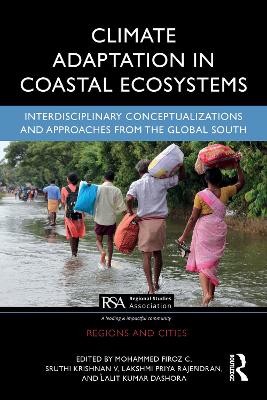
This volume brings together perspectives from urban and regional planning, architecture, environmental studies, disaster management, public policy and social sciences to explore how climate risks are reshaping coastal urban systems, governance structures, and development trajectories affecting communities.
Coastal cities and regions in the global south are some of the most vulnerable regions susceptible to climate change impacts. They experience escalating risks from sea-level rise, extreme weather patterns, ecosystem loss and degradation, along with sporadic urbanization. These regions range from small cities to metropolitan areas and peri-urban settlements. The climate impacts are critical to livelihood aspects, stability of the ecosystem and the economy of the locality. However, they are often ignored in the mainstream urban environmental planning domain.
Climate Adaptation in Coastal Ecosystems: Interdisciplinary Conceptualizations and Approaches from the Global South offers a group of scientific interdisciplinary chapters compiled together. The volume brings together perspectives from urban and regional planning, architecture, environmental studies, disaster management, public policy, and social sciences to explore how climate risks are reshaping coastal urban systems, governance structures, and development trajectories affecting the communities at large. The book is divided into four thematic sections: namely, marginalized communities, heritage and tourism, governance strategies, and governance policies. The compilation presents empirically grounded case studies mostly from the global south. It analyzes several themes ranging from gendered vulnerability, livelihood management, ecosystem-based planning, climate risks, economic development and institutional and governance reforms, in response to the changing climate.
The book will be of interest to scholars, researchers, policymakers, and practitioners engaged in urban studies, regional planning, and climate adaptation in coastal contexts.
Introduction
1. Climate Adaptation in Coastal Ecosystems:
Interdisciplinary Conceptualizations and Approaches from the Global South
Marginalized Communities
2. Applying the Livelihood Vulnerability Index to
assess the gendered vulnerability to climate change in the coastal community
of Man Thai Ward, Da Nang City, Vietnam
3. Women-centric approaches in
framing proactive disaster management strategies in the Indian state of
Odisha
4. From Predictions to Protection: How Climate Information Services is
Ushering Resilience Among Coastal Farming Communities in Bangladesh
5.
Indigenous Landscape as Response to Flood Risk in Coastal Urban Slums:
Dharavi Slum, Mumbai Heritage/Tourism
6. Framework for assessing coastal
tourism carrying capacity, a case of Puducherry, India
7. Transition from
Vulnerability to Resilience through Adaptive Strategies: Insights from
Tourism-Linked Communities of Mousuni Island, West Bengal
8. Unveiling the
Invisible: The Ethnography of Intangible Heritage in a Coastal Fishing
Community, Odisha
9. Unveiling the Potential of Heritage Tourism: A Case
Study of Kumortuli and Kolkata's River Bank Governance Strategies
10.
Monitoring changes in coastal wetlands in cities to inform climate change
adaptation strategies: The case of Songhor Lagoon in Ghana
11. Green Roof
System and Assessing Key Parameters for Runoff Reduction and Water Retention
12. Assessing Community Resilience to Climate Change in Small Islands: A Case
in Pasaran Island, Bandar Lampung , Indonesia
13. Exploring Community
Resilience to Coastal Disasters: A Case Study of Sagar Island in the
Sundarbans, West Bengal Governance Policies
14. Climate Resilient
Infrastructure: Conceptualizing Ecosystem Services Approach for Landscape
Planning and Management in Coastal Areas of India
15. Resilience of the
Fishing Community to Coastal hazards induced by the Climate Change: A Case of
Edavanakkad and Pattanakkad panchayat in Kerala State
16. The Need and
Challenges for Municipal Marine Spatial Planning for Urban Seascapes
17.
Exploring Existing Waste Management Initiatives along Thiruvananthapuram
Coast for Informed Climate Change Governance and Policy Measures Conclusion
18. Conclusions - Policy Recommendations for Climate Adaptation in Coastal
Ecosystems in the Global South
Mohammed Firoz C is Associate Professor at f the Department of Architecture and Planning, National Institute of Technology, Calicut, India and Chairperson at the Centre for Climate Resilience and Disaster Management.
Sruthi Krishnan V is Assistant Planner at the Department of Planning, Offaly County Council, Ireland.
Lakshmi Priya Rajendran is Associate Professor at the The Bartlett School of Architecture, University College London, United Kingdom.
Lalit Kumar Dashora is Urban Risk and Resilience Specialist at the School of Global Studies, Thammasat University, Bangkok, Thailand.