Muutke küpsiste eelistusi

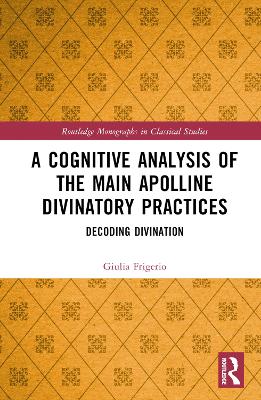
Cognitive Analysis of the Main Apolline Divinatory Practices: Decoding Divination [Kõva köide]

  • Formaat: Hardback, 198 pages, kõrgus x laius: 234x156 mm, kaal: 453 g, 16 Halftones, black and white; 16 Illustrations, black and white
  • Sari: Routledge Monographs in Classical Studies
  • Ilmumisaeg: 05-May-2023
  • Kirjastus: Routledge
  • ISBN-10: 103241152X
  • ISBN-13: 9781032411521
  • Kõva köide
  • Hind: 149,06 €*
  • * hind on lõplik, st. muud allahindlused enam ei rakendu
  • Tavahind: 198,75 €
  • Säästad 25%
  • Raamatu kohalejõudmiseks kirjastusest kulub orienteeruvalt 3-4 nädalat
  • Kogus:
  • Lisa ostukorvi
  • Tasuta tarne
  • Tellimisaeg 2-4 nädalat
  • Lisa soovinimekirja
  • Raamatukogudele
  • Formaat: Hardback, 198 pages, kõrgus x laius: 234x156 mm, kaal: 453 g, 16 Halftones, black and white; 16 Illustrations, black and white
  • Sari: Routledge Monographs in Classical Studies
  • Ilmumisaeg: 05-May-2023
  • Kirjastus: Routledge
  • ISBN-10: 103241152X
  • ISBN-13: 9781032411521

This volume takes an innovative interdisciplinary approach to investigating divination procedures at sanctuaries of Apollo in Classical and Hellenistic Greece, merging neuroscience, psychology, and behavioural studies with archaeology.

Through a deep analysis of primary sources and the historical and cultural context of these procedures, Frigerio reconstructs the precise schemata of knowledge and cognitive associations pertaining to ancient visitors of the Oracle, highlighting neural inputs they received inside their minds in these specific situations. The author engages with the archaeological record, studying the cognitive input that both seekers and prophets experienced from features of the outside world such as landscape, architecture, and temperature. This innovative methodology allows for a new understanding of divinatory practices and the formulation of new hypotheses. In addition, this study offers a powerful tool for decoding divination and engaging with the archaeological record in future research.

A Cognitive Analysis of the Main Apolline Divinatory Practices

is a fascinating read for students and scholars working on divination and cognition in ancient Greek religion, as well as in religion in the Classical and Hellenistic periods more broadly.


This volume takes an innovative interdisciplinary approach to investigating divination procedures at sanctuaries of Apollo in Classical and Hellenistic Greece, merging neuroscience, psychology, and behavioural studies with archaeology. Suitable for students and scholars working on divination and cognition in ancient Greek religion.

Arvustused

"[ This book] is a very welcome addition to a new interdisciplinary trend in the study of ancient divination. Frigerio has offered a monograph that goes beyond banalities and normative readings of ancient Greek religious practices that typically stick to textual-alone analyses, thereby inviting the interested reader to think outside the box, based on a combination of texts, archaeological findings, material culture, space and spatiality, and the cognitive mechanisms of human brain and mind." - Gnomon

Introduction;
1. A selection of the main cognitive theories applied;
SECTION I Landscape and Apolline divination: A cognitive study;
2.
Landscape agency and cognition at the sanctuary of Apollo at Delphi;
3.
Landscape agency and cognition at the sanctuaries of Apollo at Claros and
Didyma; SECTION II Architecture and Apolline divination: A cognitive study;
4. Architecture and cognition at the sanctuary of Apollo at Delphi;
5.
Architecture and cognition at the sanctuaries of Apollo at Claros and Didyma;
SECTION III Material culture and the prophets of Apollo: A cognitive study;
6. Material culture and cognition at the sanctuary of Apollo at Delphi;
7.
Material culture and cognition at the sanctuaries of Apollo at Claros and
Didyma; CONCLUSIONS.
Giulia Frigerio recently completed her PhD at the University of Kent, where she is currently teaching modules in Classical and Archaeological Studies. Her passion for Divination and Cognitive Archaeology was born during her studies for a Bachelors degree at the University of Pavia and developed further during work for her Masters degree at the University of Oxford.