Muutke küpsiste eelistusi

Comics in Contemporary Arab Culture: Politics, Language and Resistance [Kõva köide]

  • Formaat: Hardback, 248 pages, kõrgus x laius: 234x156 mm, kaal: 531 g, 50 bw integrated, 12 colour in 8pp plates
  • Ilmumisaeg: 13-Dec-2018
  • Kirjastus: I.B. Tauris
  • ISBN-10: 1784539856
  • ISBN-13: 9781784539856
  • Kõva köide
  • Hind: 123,75 €*
  • * hind on lõplik, st. muud allahindlused enam ei rakendu
  • Tavahind: 165,00 €
  • Säästad 25%
  • Raamatu kohalejõudmiseks kirjastusest kulub orienteeruvalt 3-4 nädalat
  • Kogus:
  • Lisa ostukorvi
  • Tasuta tarne
  • Tellimisaeg 2-4 nädalat
  • Lisa soovinimekirja
  • Formaat: Hardback, 248 pages, kõrgus x laius: 234x156 mm, kaal: 531 g, 50 bw integrated, 12 colour in 8pp plates
  • Ilmumisaeg: 13-Dec-2018
  • Kirjastus: I.B. Tauris
  • ISBN-10: 1784539856
  • ISBN-13: 9781784539856
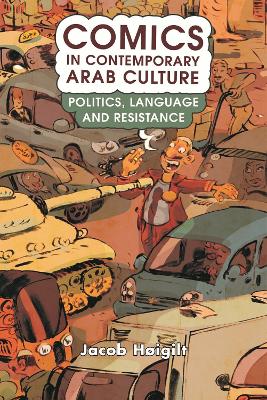
Comic books for adults have become one of the most novel and colourful forms of cultural expression in the Arab world today. During the last ten years, young Arabs have crafted stories explaining issues such as authoritarianism, resistance, war, sex, gender relations and youth culture. These are distributed through informal channels as well as independent bookstores and websites. Events like the annual Cairocomix festival in Egypt and the Mahmoud Kahil Award in Lebanon evidence the importance of this cultural phenomenon. Comics in Contemporary Arab Culture focuses on the production of these comics in Egypt and Lebanon, countries at the forefront of the development of the genre for adults. Jacob Hoigilt guides the reader through the emergence of independent comics, explores their social and political critique, and analyses their visual and verbal rhetoric. Analysing more than 50 illustrations, included here, he shows that Arab comics are revealing of the changing attitudes towards politics, social relations and even language. While political analysts often paint a bleak picture of the Arab world after 2011, this book suggests that art and storytelling continue to nourish a spirit of liberty and freedom despite political setbacks. Comics in Contemporary Arab Culture provides a fresh and original insight into the politics of the Middle East and cultural expression in the Arab World.

Arvustused

An engaging read for all those interested in Arab culture, comics, the use of language as a political tool, and forms of artistic expression. * Blog de l'Escola de Llibreria *

Muu info

Explains this cultural phenomenon of comics in the Arab World and their social and political critique
List of Figures and Plates
vii
Acknowledgements x
A Note on Transliteration xii
1 Introduction
1(14)
Scope and themes
6(4)
The analysis of comics
10(2)
Structure of the book
12(3)
2 Mapping the scene
15(14)
3 Resistance against authoritarianism and war: Adult comics before 2011
29(29)
A tradition of political critique: War comics in Lebanon
37(16)
Critique of authoritarianism in Samandal magazine
53(5)
4 Comics in revolutionary and post-revolutionary Egypt
58(27)
Drawing a revolution
60(9)
Revolutionary criticism and humour in Egyptian comics
69(16)
5 Gender relations
85(41)
Gender relations: A core issue
93(6)
Slapstick humour and exaggerations
99(8)
Visual symbolism
107(4)
The rhetoric of the panels
111(9)
In favour of the sensitive man
120(6)
6 Youthfulness and the vernacular
126(35)
The marginalization of youth in the Arab world
127(2)
Asserting youthfulness
129(7)
Individuality and alienation
136(7)
Youthfulness and the vernacular
143(18)
7 Comics and sociolinguistics: Informal literacy, voice and language ideology
161(31)
Inhabiting a third space
163(7)
Voice
170(3)
Diglossia and written Arabic
173(2)
Language ideology and the illusion of zero-sum games
175(11)
Informal literacy and the ideology of diglossia
186(6)
8 Conclusion: Ideology, resistance and voice
192(4)
Notes 196(16)
Bibliography 212(11)
Index 223
Jacob Hoigilt is Senior Researcher at the Peace Research Institute, Oslo, and Adjunct Associate Professor in the Department of Culture Studies and Oriental Languages, University of Oslo. He was previously Senior Researcher at the Fafo Institute for Applied International Studies. He has published the monograph Islamist Rhetoric: Language and Culture in Contemporary Egypt as well as in various edited collections and journals.