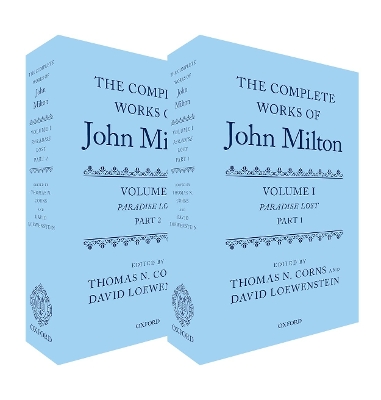
This edition of Paradise Lost (1667, 1674) makes its own distinctive contribution to the editorial tradition. It presents the two lifetime versions of Milton's poem in juxtaposition with each other. However, unlike previous scholarly editions it does not attempt to synthesise the two lifetime versions into a text that never existed. Nor does it privilege the later version over the earlier. It presents, too, a new intellectual context for interpreting the work, demonstrating its intricate intersections with the political and religious controversies of its age, and it connects it more closely than hitherto with Milton's major theological treatise, De Doctrina Christiana. It also offers a more detailed account of its publishing history and the highly unusual organisation within the booktrade, contrived to distribute Milton's finest achievement in an England devastated by the Great Fire of London.
This edition of Paradise Lost (1667, 1674) presents the two lifetime versions of Milton's poem in juxtaposition with each other, with a new intellectual context for interpreting the work, demonstrating its intricate intersections with the political and religious controversies of its age.
Volume 1 Preface Illustrations References, Abbreviations, and Short
Titles Editorial Procedures General Introduction Textual Introduction
Illustrations to the Title Pages to Paradise Lost Paradise Lost 1667-1669 and
1674 Volume 2 Illustrations References, Abbreviations, and Short Titles
General Commentary Textual Commentary Appendix 1: The Manuscript of Paradise
Lost, Book 1 Appendix 2: The Contract for the First Edition of Paradise Lost
Appendix 3: The Second Printing of Sheet Z and Half-Sheet Vv Index to the
Introductions and Commentaries
Thomas N. Corns is Emeritus Professor of English Literature at Bangor University. He is (with Gordon Campbell) General Editor of The Complete Works of John Milton, a Fellow of the British Academy, and an Honored Scholar of the Milton Society of America. With Gordon Campbell he wrote John Milton: Work, Life, and Thought, and with Ann Hughes and David Loewenstein, he edited The Complete Works of Gerrard Winstanley. Other publications include Milton's Language (1990), Uncloistered Virtue: English Political Literature 1640DS1660 (1992), Regaining 'Paradise Lost' (1994), and A History of Seventeenth-Century English Literature (2007). David Loewenstein is Edwin Erle Sparks Professor of English and the Humanities at Penn State University-University Park. He previously taught at the University of Wisconsin-Madison as Helen C. White Professor of English and the Humanities. His extensive publications on early modern literary culture include Representing Revolution in Milton and His Contemporaries: Religion, Politics, and Polemics in Radical Puritanism (2001), The Cambridge History of Early Modern English Literature (2002; co-editor), Treacherous Faith: The Specter of Heresy in Early Modern English Literature and Culture (2013), and John Milton, Prose: Major Writings on Liberty, Politics, Religion, and Education (2013; editor), and Shakespeare and Early Modern Religion (2015; co-editor). He has been a Guggenheim Fellow, as well as a NEH Fellow at the Newberry Library and Folger Shakespeare Library; and he has held visiting fellowships at Churchill College, Cambridge and at Lady Margaret Hall and Merton College, Oxford. He is an Honored Scholar of the Milton Society of America.