Muutke küpsiste eelistusi

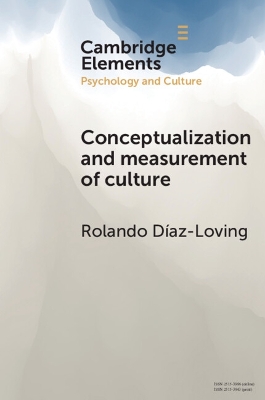
Conceptualization and Measurement of Culture: The Historic-Sociocultural Premises [Pehme köide]

(National Autonomous University of Mexico)
  • Formaat: Paperback / softback, 75 pages, Worked examples or Exercises
  • Sari: Elements in Psychology and Culture
  • Ilmumisaeg: 31-May-2026
  • Kirjastus: Cambridge University Press
  • ISBN-10: 100968504X
  • ISBN-13: 9781009685047
  • Pehme köide
  • Hind: 20,48 €*
  • * hind on lõplik, st. muud allahindlused enam ei rakendu
  • Tavahind: 27,30 €
  • Säästad 25%
  • See raamat ei ole veel ilmunud. Raamatu kohalejõudmiseks kulub orienteeruvalt 3-4 nädalat peale raamatu väljaandmist.
  • Kogus:
  • Lisa ostukorvi
  • Tasuta tarne
  • Tellimisaeg 2-4 nädalat
  • Lisa soovinimekirja
  • Formaat: Paperback / softback, 75 pages, Worked examples or Exercises
  • Sari: Elements in Psychology and Culture
  • Ilmumisaeg: 31-May-2026
  • Kirjastus: Cambridge University Press
  • ISBN-10: 100968504X
  • ISBN-13: 9781009685047
The debate over the relative merits of adopting functional universal psychological principles, processes, and constructs (etics) versus particular structural idiosyncratic characteristics and behaviors distinct to specific cultural groups (emics) has been present in the anthropological and psychological literature for decades. Evident in the discussion is that the basic principles and processes tend to be universal, whereas theoretical concepts and to a greater extent personal attributes, behavioral patterns, norms, beliefs, attitudes, and values have an indigenous base. Recurring crises within the Euro-Meso-North-American scientific psychological tradition are traceable to the lack of cultural and eco-systemic sensitivity and an attempt to indiscriminately generalize findings across behavioral settings. Psychology requires an approach that integrates behavioral and cultural models for which an independent measure of structural sociocultural variables are included. The main argument presented within this manuscript is that the measurement of historic-sociocultural premises (norms and beliefs) achieve such a purpose.

Muu info

Culture underlies psychology, poorly defined; this Element offers a rigorous framework and measures for precise, valid research.
1. Introduction: Why Culture Still Needs Conceptual Clarification;
2.
Defining Culture in Psychological Science;
3. The Sociocultural Ecosystem:
Culture as a System of Norms, Beliefs, and Meanings;
4.
HistoricalSociocultural Premises: Conceptual Foundations;
5. Methodological
Development of HistoricalSociocultural Premises;
6. HistoricalSociocultural
Premises across Schooling and Gender;
7. Norms and Beliefs: Differentiating
Cultural Regulatory Systems;
8. Construct Validity of
HistoricalSociocultural Premises;
9. The Multilevel Influence of Culture on
Psychological and Social Dynamics;
10. Conclusions: Toward a Culturally
Grounded Psychological Science; References.