Muutke küpsiste eelistusi

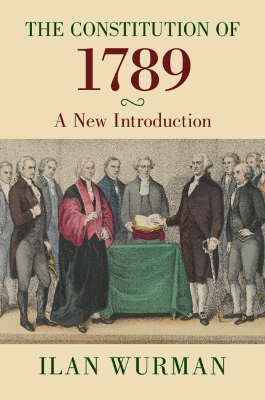
Constitution of 1789: A New Introduction [Pehme köide]

(University of Minnesota Law School)
  • Formaat: Paperback / softback, 416 pages, Worked examples or Exercises
  • Ilmumisaeg: 18-Jun-2026
  • Kirjastus: Cambridge University Press
  • ISBN-10: 1009485695
  • ISBN-13: 9781009485692
  • Pehme köide
  • Hind: 24,53 €*
  • * hind on lõplik, st. muud allahindlused enam ei rakendu
  • Tavahind: 32,70 €
  • Säästad 25%
  • See raamat ei ole veel ilmunud. Raamatu kohalejõudmiseks kulub orienteeruvalt 3-4 nädalat peale raamatu väljaandmist.
  • Kogus:
  • Lisa ostukorvi
  • Tasuta tarne
  • Tellimisaeg 2-4 nädalat
  • Lisa soovinimekirja
  • Formaat: Paperback / softback, 416 pages, Worked examples or Exercises
  • Ilmumisaeg: 18-Jun-2026
  • Kirjastus: Cambridge University Press
  • ISBN-10: 1009485695
  • ISBN-13: 9781009485692
The Constitution of 1789 is a new introduction to the Constitution written on the semiquincentennial of American Independence, packed with novel and surprising insights about the Constitution's original meaning. The book takes the reader on an in-depth tour of the Constitution's structure and separation of powers, starting with the nature of written constitutions and the compound nature of the American Union. The book also explores the enumeration of legislative powers and its relation to the historic royal prerogatives, the meaning of executive power, and the distribution of foreign affairs and war powers between Congress and the President. It investigates the nature of judicial power and the Constitution's complex relationship with slavery, before addressing federalism and the scope of national powers. The Constitution of 1789 dismantles several common misconceptions and conventional wisdoms and is suitable for all readers interested in the law, politics, and history of the American Republic.

Arvustused

'An impressively sweeping yet accessible interpretation of the Constitution through the lens of originalism, the method that now prevails on the Supreme Court. Wurman powerfully illuminates debates among originalists on how their method applies to crucial questions. He intervenes in those debates with sophistication, wit and scholarly zest.' Nicholas Parrillo, William K. Townsend Professor of Law and Professor of History, Yale University, and author of Against the Profit Motive: The Salary Revolution in American Government, 1780 1940 'Comprehensive, clear-headed and packed with essential information, The Constitution of 1789 is terrific one-stop shopping to our nation's founding document and to many of the great issues of the modern era.' Cass R. Sunstein, Robert Walmsley University Professor, Harvard University, and author, How to Interpret the Constitution 'This is a marvelous simultaneously sophisticated and accessible introduction to the world of structural constitutionalism. It provokes careful thought on virtually every page.' Gary Lawson, University of Florida Levin College of Law, and co-author of 'A Great Power of Attorney': Understanding the Fiduciary Constitution 'Lucid, careful, precise, intelligent, eminently sensible, and a pleasure to read - this exposition of the meaning of the Constitution ratified by the people of the United States in 1788 is unexcelled. Students, legal scholars, historians, and politically alert laymen will find it indispensable.' Paul A. Rahe, Professor of History, Hillsdale College, and author of Republics Ancient and Modern

Muu info

A new introduction to the Constitution's original meaning on the semiquincentennial of American Independence, with novel insights.
Introduction; Part I. Constitutional Union:
1. The written constitution;
2: The compound republic; Part II. The Legislative Power:
3. Enumeration;
4.
Implied powers; Part III. The Executive Power:
5. Creating the presidency;
6.
Overseeing law execution;
7. The fourth branch; Part IV. Separation of Powers
(I):
8. Emergency powers;
9. Foreign affairs;
10. War; Part V. Separation of
Powers (II):
11. Nondelegation;
12. The legislative veto; Part VI. The
Judicial Power:
13. Article III and judicial review;
14. Dred Scott: the
constitution and slavery;
15. Departmentalism; Part VII. Federalism:
16.
Commerce;
17. State sovereignty;
18. Taxing and spending.
Ilan Wurman is the Julius E. Davis Professor of Law at the University of Minnesota. He is also the author of The Second Founding: An Introduction to the Fourteenth Amendment (2020) and A Debt against the Living: An Introduction to Originalism (2017), as well as a leading casebook on administrative law. He splits his time between Saint Paul, Minnesota, and rural Arizona.