Muutke küpsiste eelistusi

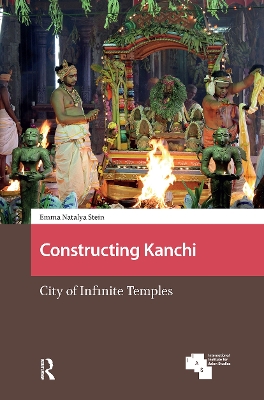
Constructing Kanchi: City of Infinite Temples [Kõva köide]

  • Formaat: Hardback, 300 pages, kõrgus x laius: 234x156 mm, 10 Illustrations, color; 90 Illustrations, black and white
  • Sari: Asian Cities
  • Ilmumisaeg: 26-Oct-2021
  • Kirjastus: Amsterdam University Press
  • ISBN-10: 9463729127
  • ISBN-13: 9789463729123
  • Kõva köide
  • Hind: 133,88 €*
  • * hind on lõplik, st. muud allahindlused enam ei rakendu
  • Tavahind: 178,50 €
  • Säästad 25%
  • Raamatu kohalejõudmiseks kirjastusest kulub orienteeruvalt 3-4 nädalat
  • Kogus:
  • Lisa ostukorvi
  • Tasuta tarne
  • Tellimisaeg 2-4 nädalat
  • Lisa soovinimekirja
  • Formaat: Hardback, 300 pages, kõrgus x laius: 234x156 mm, 10 Illustrations, color; 90 Illustrations, black and white
  • Sari: Asian Cities
  • Ilmumisaeg: 26-Oct-2021
  • Kirjastus: Amsterdam University Press
  • ISBN-10: 9463729127
  • ISBN-13: 9789463729123
Constructing Kanchi: City of Infinite Temples traces the emergence of the South Indian city of Kanchi as a major royal capital and multireligious pilgrimage destination during the era of the Pallava and Chola dynasties (ca. seventh through thirteenth centuries). The book presents the first-ever comprehensive picture of historical Kanchi, locating the city and its more than 100 spectacular Hindu temples at the heart of commercial and artistic exchange that spanned India, Southeast Asia, and China. The author demonstrates that Kanchi was structured with a hidden urban plan, which determined the placement and orientation of temples around a central thoroughfare that was also a burgeoning pilgrimage route. Moving outwards from the city, she shows how the transportation networks, river systems, residential enclaves, and agrarian estates all contributed to the vibrancy of Kanchi’s temple life. The construction and ongoing renovation of temples in and around the city, she concludes, has enabled Kanchi to thrive continuously from at least the eighth century, through the colonial period, and up until the present. 1) The book is the first ever comprehensive history of Kanchi, an important South Indian city that is often left on the margins of scholarly studies. 2) The book integrates structures typically looked at in isolation and instead treats them as players within a larger geo-spatial, spiritual, and urban geography. 3) The book cuts across disciplines and builds upon scholarship on urbanism, religious architecture, history, and landscape studies.
Acknowledgments 9(14)
List of Illustrations
13(10)
Note on Transliteration, Translation, and Illustrations 23(2)
Introduction 25(18)
All Streets Lead to Temples
An Ancient City
30(4)
Layers of Time
34(4)
Kanchi Known and Unknown
38(5)
1 Sandstone and the City
43(60)
Building Pallava-Kanchi (ca. seventh through ninth century)
From Brick to Stone (the Seventh Century)
46(17)
Sandstone Temples in the City (the Eighth Century)
63(5)
The Temples of Pallava-Kanchi
68(24)
Everywhere but Kanchi (the Ninth Century)
92(9)
Conclusion: Foundations Laid
101(2)
2 Realignment
103(50)
Kanchi in the Chola Era (ca. tenth through thirteenth century)
Orienting the Gods
105(21)
Pilgrimage and Processions
126(10)
From Ancient Village to Temple Town
136(12)
Local Style
148(3)
Conclusion: Urban Logic
151(2)
3 The City and its Ports
153(46)
Part 1 KSETRA
156(1)
The River Networks
156(9)
Over the Hills
165(7)
The Coast
172(10)
Part II KSATRA
182(1)
Kanchi in a Buddhist World
182(11)
The City and its Mirrors
193(3)
Conclusion: From Kanchi to the Sea
196(3)
4 Kanchi Under Colonialism
199(68)
What Happened in Kanchi while those Towering Gateways Arose?
205(3)
Embattled Territory
208(14)
William Daniell's Most Considerable Temple
222(3)
James Wathen's Soaring View
225(4)
Henrietta Clive's `Hindoo Gods and Monsters'
229(5)
Colonel Colin Mackenzie's Search for the Jains
234(8)
Surgeon George Russell Dartnell
242(3)
James Fergusson's Downward Spiral
245(8)
Prince Alexis Soltykoff's `City of Infinite Temples'
253(10)
Conclusion: Plastered Pasts
263(4)
Epilogue
267(8)
The Living Temple
Encounter
267(1)
Expansion
268(3)
Continuation
271(4)
Bibliography 275(20)
Index 295
Emma Natalya Stein (PhD, Yale) is Assistant Curator of South and Southeast Asian Art at the Freer Gallery of Art and Arthur M. Sackler Gallery, the Smithsonian's National Museum of Asian Art. Her research investigates the relationships among sacred architecture, urban space, and tropical landscapes. Dr. Stein has conducted fieldwork throughout South and Southeast Asia.