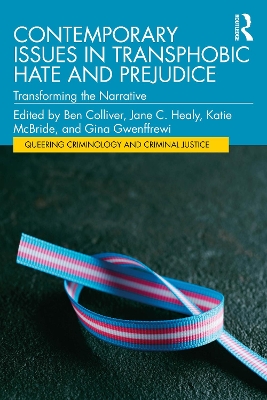
Bringing together international research and perspectives on bias, prejudice, and hatred towards transgender communities, this collection explores the ways in which transphobia manifests across different times and spaces, addressing an important contemporary issue and filling the current gap in hate studies literature.
This book comes at a crucial time, in which gender identity has become a divisive political tool, contributing to a social climate in which transgender people have become legitimate targets for suspicion, discrimination, and hate. Exploring contemporary debates surrounding transphobic hate crime, the book focuses on understanding transphobic hate crime, examining criminal justice and policy responses, analysing spaces and places where transphobia manifests, and delving into discourse, representation, and construction of transgender identities. Showcasing a diversity of research from across the criminological disciplinary landscape and through research that deploys an innovative array of methodological approaches, this book seeks to contribute to the growing canon of academic research into experiences of transphobic hate crime and provides important insights at a time of unprecedented political, social, and direct threats to trans people’s lives.
Presenting research that is both important and innovative, Contemporary Issues in Transphobic Hate and Prejudice will be of great interest to students and scholars working within the disciplines of Criminology, Sociology, Gender Studies, Law, Media Studies, and Queer Studies.
Bringing together international research and perspectives on bias, prejudice and hatred towards transgender communities, this collection explores the ways in which transphobia manifests across different times and spaces, addressing an important contemporary issue and filling the current gap in hate studies literature.
1. Introduction: Naming Violence, Resisting Erasure Transphobia and
the Politics of Hate Section One: Understanding Identities and Transphobia
2.
Transgressing social norms: Understanding transphobia and hostility against
gender-diverse communities
3. Anti-trans activism: an overview
4. An
intersectional lens on the experiences of young transgender and non-binary
people in the UK Section Two: Global Patterns in Policy and Practice
5.
Prison abolition and the case of CeCe McDonald
6. Addressing jury stigma
towards transgender victims of hate crimes
7. Transphobic hate crime in
illiberal democracies: A case study of Poland
8. Fatal transgender hate
crimes in America: Accounts from a newly established transgender homicides
database
9. A cross-sectional study on transphobia, compassion and crime
perception in Germany Section Three: Space, Place & Transphobia
10.
Occupational hazards: The silent violence experienced by trans women at work
11. "A storm is coming": Deconstructing Doxxing
12. Microaggressions,
prejudice, and harm: Perceptions and experiences of transgender and gender
non-conforming individuals on Grindr Section Four: Discourse, Representation
and Construction
13. Isla Bryson and the burden of representation:
inflammatory media coverage of trans women in the U.K. in 2023
14. "Bloody
pronouns": Transphobic online hate since the proposed amendments to the
Gender Recognition Act (GRA) 2018
15. Concluding thoughts: intersecting
identity, risk and harm for trans communities
Ben Colliver is an Associate Professor of Criminology at Birmingham City University, UK.
Jane C. Healy is a Visiting Fellow in Criminology at Bournemouth University, UK.
Katie McBride is a Criminologist and Associate Head of School at the University of Plymouth, UK.
Gina Gwenffrewi is a lecturer and researcher in culture and media through the prism of Trans and Queer Studies at the University of Edinburgh.