Muutke küpsiste eelistusi

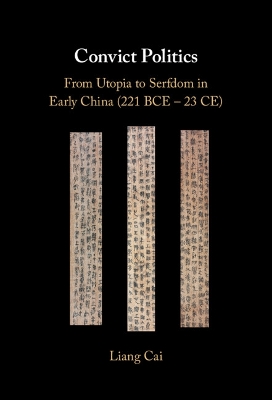
Convict Politics: From Utopia to Serfdom in Early China (221 BCE 23 CE) [Kõva köide]

(University of Notre Dame, Indiana)
  • Formaat: Hardback, 444 pages, kõrgus x laius x paksus: 229x152x25 mm, kaal: 825 g, Worked examples or Exercises
  • Ilmumisaeg: 19-Jan-2026
  • Kirjastus: Cambridge University Press
  • ISBN-10: 1316515303
  • ISBN-13: 9781316515303
Teised raamatud teemal:
  • Kõva köide
  • Hind: 113,62 €*
  • * hind on lõplik, st. muud allahindlused enam ei rakendu
  • Tavahind: 151,50 €
  • Säästad 25%
  • Raamatu kohalejõudmiseks kirjastusest kulub orienteeruvalt 3-4 nädalat
  • Kogus:
  • Lisa ostukorvi
  • Tasuta tarne
  • Tellimisaeg 2-4 nädalat
  • Lisa soovinimekirja
  • Formaat: Hardback, 444 pages, kõrgus x laius x paksus: 229x152x25 mm, kaal: 825 g, Worked examples or Exercises
  • Ilmumisaeg: 19-Jan-2026
  • Kirjastus: Cambridge University Press
  • ISBN-10: 1316515303
  • ISBN-13: 9781316515303
Teised raamatud teemal:
In this innovative history, Liang Cai examines newly excavated manuscripts alongside traditional sources to explore convict politics in the early Chinese empires, proposing a new framework for understanding Confucian discussions of law and legal practice. While a substantial number of convict laborers helped operate the local bureaucratic apparatus in early China, the central court re-employed numerous previously convicted men as high officials. She argues that convict politics emerged, because, while the system often criminalized individuals, including the innocent, it was simultaneously juxtaposed with redemption policies and frequent amnesties in pursuit of a crime-free utopia. This dual system paralyzed the justice system, provoking intense Confucian criticism and resulting in a deep-seated skepticism toward law in the Chinese tradition, with a long-lasting political legacy.

Arvustused

'Professor Cai solidifies her position as a leading scholar of ancient legal and political history. Her meticulous research, based on historical texts and excavated documents, brilliantly exposes the cruelty and paradoxes of the 'open prison' that was the Han Empire. The legacy of such systems continues to shape contemporary China.' Anthony J. Barbieri-Low, co-author of Law, State, and Society in Early Imperial China 'Cai arrestingly recasts our image of the Qin and Han Dynasties. These regimes' laws were not meant to be cruel, but to bring about a crime-free utopia. Nevertheless, these performance-based dictates made criminals of both commoner and official alike. A supposed utopia became a dystopia in which convicts ruled convicts.' Keith Knapp, co-editor of The Cambridge History of China: Volume 2, The Six Dynasties, 220589 'A fascinating and horrifying study of the inner workings of the Qin and Han penal system, which criminalized vast swathes of the population to exploit them as forced labor. Liang Cai offers an outstanding analysis of the cruel injustices perpetrated in creating a realm of offenders.' Olivia Milburn, University of Hong Kong 'In her thought-provoking monograph, Cai Liang explores how the quest for legal-administrative perfectionism in early Chinese empire created a paradox: notoriously harsh laws, which created an army of convicts, were undermined by excessive laxity of repeated amnesties. Scholars of China's imperial history and comparatists will benefit immensely from Cai's insights.' Yuri Pines, The Hebrew University of Jerusalem

Muu info

Utilising excavated manuscripts, Cai reveals a historical paradox: the quest for a crime-free utopia criminalized early Chinese empires.
Introduction; Part I. Criminalizing the Empire:
1. Convict politics and
convict economy: administrative space as open prison in local governments;
2.
Convicts as officials: disparities between philosophical ideals and
real-world politics;
3. Mutual responsibility system: criminalizing the
innocent;
4. Brutal perfectionism: criminalizing job performance and collapse
of justice;
5. Performance legitimacy: absolute liabilities, heavy
punishments and collective lies; Part II. A Paralyzed Justice System:
'Creating' Unlawful Commoners via Redemption and Amnesty;
6. Redemption:
political economy and sacrificed justice;
7. Imperial amnesty: correcting the
excessive punishment and regaining loyalty;
8. Universal amnesty: from
Utopian dream to His Majesty's splendor;
9. The Body politic and the parents
metaphor: universal amnesty and the loss of individual justice; Part III. The
Critics and Their Failure in Reform;
10. Technical bureaucrats' law and
Confucian virtue: political elites and bureaucratic hierarchy;
11. Tutor to
the Crown Prince and Chancellor of the empire: Confucian dream and political
reality in Western Han China (206 BCE-9 CE); Conclusion: From philosophical
ideals to practical realities.
Liang Cai is Associate Professor of History at the University of Notre Dame.