Muutke küpsiste eelistusi

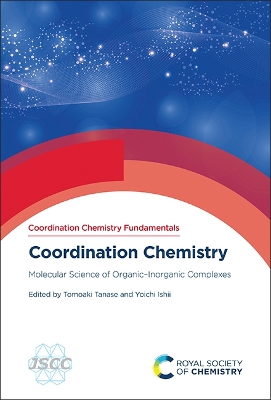
Coordination Chemistry: Molecular Science of OrganicInorganic Complexes [Kõva köide]

Edited by (Chuo University, Japan), Edited by (Nara Women's University, Japan)
  • Formaat: Hardback, 444 pages, kõrgus x laius x paksus: 234x156x27 mm, kaal: 848 g
  • Sari: Coordination Chemistry Fundamentals Series Volume 3
  • Ilmumisaeg: 16-Oct-2024
  • Kirjastus: Royal Society of Chemistry
  • ISBN-10: 1837670641
  • ISBN-13: 9781837670642
  • Kõva köide
  • Hind: 73,12 €*
  • * hind on lõplik, st. muud allahindlused enam ei rakendu
  • Tavahind: 97,50 €
  • Säästad 25%
  • Raamatu kohalejõudmiseks kirjastusest kulub orienteeruvalt 3-4 nädalat
  • Kogus:
  • Lisa ostukorvi
  • Tasuta tarne
  • Tellimisaeg 2-4 nädalat
  • Lisa soovinimekirja
  • Formaat: Hardback, 444 pages, kõrgus x laius x paksus: 234x156x27 mm, kaal: 848 g
  • Sari: Coordination Chemistry Fundamentals Series Volume 3
  • Ilmumisaeg: 16-Oct-2024
  • Kirjastus: Royal Society of Chemistry
  • ISBN-10: 1837670641
  • ISBN-13: 9781837670642

Translated from the original Japanese, this book is for undergraduate and graduate students as well as young researchers beginning their exploration of coordination chemistry.


New to coordination chemistry and looking for some straightforward resources?

In this long-established field of science, developments have continued between disciplines. Thus, modern coordination chemistry is recognized as an interdisciplinary molecular science that has developed at the intersection of inorganic and organic chemistry. Translated from the original Japanese, this accessible book is for undergraduate and graduate students and young researchers new to coordination chemistry. It explores transition metal complexes involving d and f orbitals and is structured as a step-by-step guide. It starts with the basics, as the foundation of the topic, progressing in complexity to explain some of the recent interdisciplinary developments. Important analytical methods related to the contents are introduced for completeness.

You need look no further for concise and easy-to-understand explanations of coordination chemistry.

Introduction: What is a Metal Complex
Structure of Metal Complexes
Electronic Structure of Metal Complexes
Optical Absorption and Emission of Metal Complexes
Magnetism of Metal Complexes
Stability of Metal Complexes and Ligand Substitution Reactions
Electron Transfer Reactions of Metal Complexes
Organometallic Complexes
Theoretical Chemistry of Metal Complexes
Assembled Metal Complexes and Their Functions
Catalytic Reactions Using Metal Complexes
Metal Complexes of Rare Earth Elements
Metal Complexes Relating to Biological Functions