Western Palestine is extremely rich in Arabic inscriptions, whose dates range from as early as ce 150 until modern times.
Most of the inscriptions date from the Islamic period, for under Islam the country gained particular religious and strategic importance, even though it made up only part of the larger province of Syria.
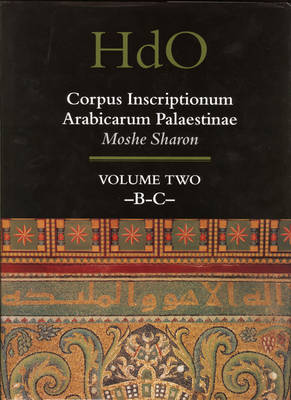
This historical importance is clearly reflected in the hundreds of inscriptions, the texts of which cover a variety of topics: construction, dedication, religious endowments, epitaphs, Qur'anic texts, prayers and invocations, all now assembled in this Corpus Inscriptionum Arabicarum Palaestinae (CIAP).
The inscriptions are arranged according to site, and are studied in their respective topographical, historical and cultural contexts. In this way the CIAP offers more than a survey of inscriptions: it represents the epigraphical angle of the geographical history of the Holy Land.
The religious and strategic importance of Western Palestine in the Islamic period is clearly reflected in the hundreds of Arabic inscriptions found, the texts of which cover a variety of topics including construction, dedication, religious endowments, epitaphs, Qur'anic texts, prayers and invocations, all now assembled in this Corpus Inscriptionum Arabicarum Palaestinae (CIAP). The inscriptions are arranged according to site, and are studied in their respective topographical, historical and cultural contexts. In this way the Corpus offers more than a survey of inscriptions: it represents the epigraphical angle of the geographical history of the Holy Land.