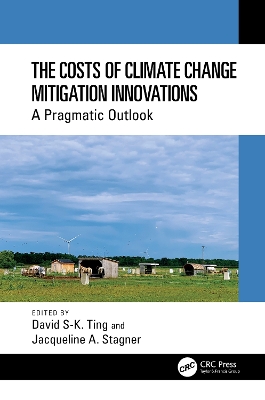
The notion that humanity may be too late to alter climate change could potentially lead to fear and therefore the advocacy of implementing radical strategies and/or hastening the execution of certain measures to the extreme. There is evidence that extensive and intensive implementation of some climate change solutions can significantly alter the environment and ecosystems in unintended ways. For example, the microclimate of a field in the proximity and downstream of a closely packed array of wind turbines can be noticeably altered by the modified lower atmospheric fluxes caused by the turbines, which can then negatively affect crop yields. Additionally, some studies have found that large-scale solar fields can result in the modulation of atmospheric circulation, leading to changes in regional precipitation.
The Costs of Climate Change Mitigation Innovations: A Pragmatic Outlook provides a forum for discussion on the long-term consequences of various climate strategies. It promotes our striving toward minimizing the potential negative impact of new interventions by performing objective, holistic analyses. The bottom line is that we do not want todays’ solutions to become tomorrow’s problems.
The notion that humanity may be too late to alter climate change could potentially lead to fear and therefore the advocacy of implementing radical strategies and/or hastening the execution of certain measures to the extreme. The bottom line is that we do not want todays’ solutions to become tomorrow’s problems.
Chapter 1 The Pros and Cons of Climate Change Mitigation Innovations.
Chapter 2 Investigating the R&D and Innovation Economic Efficiencies of the
Renewable Energy Sectors in EU.
Chapter 3 BIMPowered Energy Efficiency and
LifeCycle Cost Analyses for Greener Design.
Chapter 4 Improving Energy
Efficiency of Tall Buildings Using Innovative Environmental Systems.
Chapter
5 Efficiency of Space Utilization in Supertall Towers with Free Forms.
Chapter 6 Linking between Renewables Development and Energy Security: A
Scoping Review.
Chapter 7 Energy Policy: Formulation, Monitoring, and
Adaptation for Moving Towards a Low Carbon Economy.
Chapter 8 Recent
Developments in LargeScale Solar Flat Plate Reflecting Systems: Optical
Analysis Using Specialized Numerical and Analytical Tools.
Chapter 9 Energy
Poverty and the Sustainable Development of Renewable Energy Systems.
Chapter
10 The Challenges of Stakeholder Engagement in Climate Change Adaptation in
Nigeria.
David S-K. Ting studied Combustion and Turbulence, followed by Convection Heat Transfer and Fluid-Structure Interactions, prior to joining the University of Windsor. Dr. Ting is the founder of the Turbulence and Energy Laboratory and a professor in the Department of Mechanical, Automotive and Materials Engineering. Professor Ting supervises students on a wide range of research topics including Energy Conservation and Renewable Energy. To date, he has co-supervised over 90 graduate students, co-authored more than 170 journal papers, authored five textbooks, and co-edited more than 25 volumes.
Jacqueline A. Stagner is the Undergraduate Programs Coordinator in the Faculty of Engineering at the University of Windsor, and an adjunct faculty member in the Department of Mechanical, Automotive and Materials Engineering. Dr. Stagner co-advises students primarily in sustainable energy in the Turbulence and Energy Laboratory. Prior to working at the University of Windsor, she attained a PhD in Materials Science and Engineering, a Master of Business Administration, and a bachelors degree in Mechanical Engineering. She also worked as a release engineer in the automotive industry for six years. She has co-edited ten volumes.